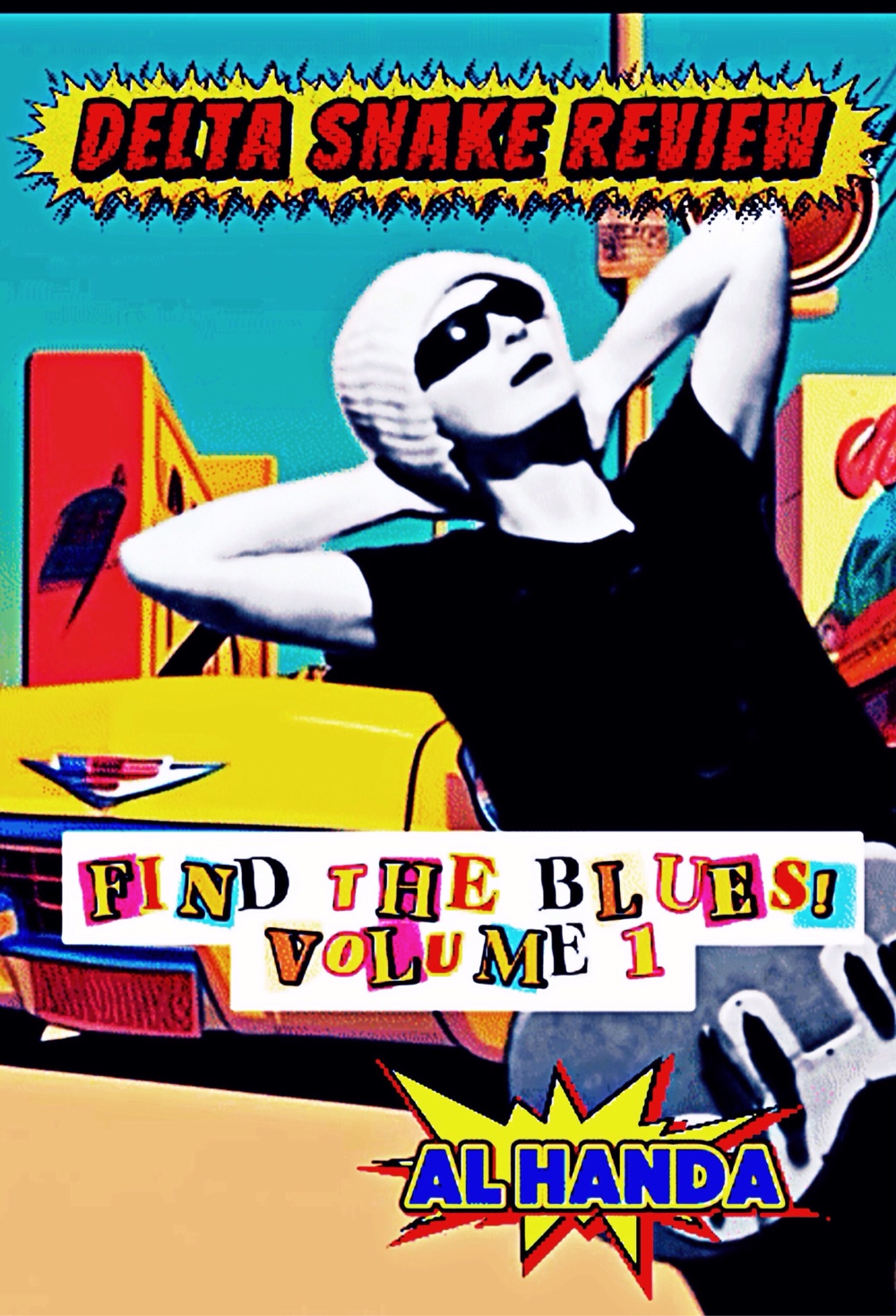
This is a digest of the record reviews from the February 1994 Delta Snake Blues News (latest changed to review)
Delta Snake Review Digest: Feb. 1997 e-zine issue
DELTA SNAKE BLUES NEWS
"Bringing the thrill back to ASCII...."
Al Handa - Editor
February '94
Vol 1 - No. 2
IN THIS ISSUE:
Note: All reviews written by Al Handa
BIG JACK JOHNSON: "The Oil Man" (EARWIG 4910CD)
ARON BURTON: "Past, Present, and Future" (EARWIG)
OLD FRIENDS: "Honeyboy Edwards, Sunnyland Slim, Big Walter Horton, Kansas City Red," and "Floyd Jones" (EARWIG)
JOHN DELAFOSE AND THE EUNICE PLAYBOYS (Featuring Geno Delafose):
"Blues Stay Away From Me" (Rounder)
BOOZOO CHAVIS & THE MAJIC SOUNDS: "Boozoo, That's Who!" (ROUNDER CD 2126)
PAUL RISHELL: "Swear To The Truth" (Tone-Cool Records)
SLIDIN'...SOME SLIDE: (Bullseye Blues CD BB 9533)
ALBERT KING - KING OF THE BLUES GUITAR (Atlantic (US) 8213-2)
BIG JACK JOHNSON: "The Oil Man" (EARWIG 4910CD)
This is a CD reissue of an 1987 vinyl release on the same label. I reviewed it in the Delta Snake of that year, and I gave it a pretty good rating. Listening to it again in `94 doesn't change my opinion of the recording. In fact, I'm surprised at how well it has stood up.
I basically called it a great bar blues album, and any fans who liked Magic Slim would like it. No truly great cuts, but lots of way above average blues one could dance to and enjoy. One difference in this set is that Jack isn't your basic shuffles-turnaround man. The vamped opening to the ancient warhorse, "Killing Floor," immediately tells the listener that this band does work on these numbers and try to come up with something different.
Like any good club band, Johnson's outfit plays a variety of tempos well. "I'm Gonna Give Up Disco And Go Back To The Blues," sports a cut-time stomp, "Steel Guitar Rag" a bit of country, "Catfish Blues" features the Delta gone heavy, and "Too Many Drivers" the solid medium tempo shuffle that is the bread and butter of any band of this type.
Those who prefer the sharper intensity of, say, an Albert Collins would probably find this CD a little too far into journeyman territory. However, I think that if you were to catch Big Jack Johnson on a good night in a crowded club, you just might think he was one hell of a good Blues man.
ARON BURTON: "Past, Present, and Future" (EARWIG)
One doesn't often see a bass player as frontman. However, his credentials become clear even after a cursory look at his credits. One of the original Icebreakers, unofficial member of the Alligator house band (pre-House Rockin), associations with Lonnie Brooks, Fenton Robinson, Eddie Taylor, Hubert Sumlin, Carey Bell, Big Jack Johnson, and others.
I should add, maybe due to Burton's particular expertise, the bass is mixed higher than usual. This can be a boon to those who prefer that nice fat, funky bottom that this man can put out.
The CD opens with "Been Down," the sort of funk number BB King should consider covering with the Crusaders. The set then alternates through a fairly standard mix of funk, shuffles, and slow ones. I don't say that to dismiss this work. I’m merely stating that the song programming is fairly standard for a modern Blues CD.
So, what would the listener find here that couldn't be found elsewhere? Nothing at first listening. I did find myself liking it a great deal after a couple of listens.mIt reminds me of Snooky Pryor's release a few years back. On the surface it was a fairly standard set of modern Chicago Blues. After a couple of listenings, I realized that it was more than standard. The playing had a lot of little touches that showed decades of experience, and to this day, is one of my favorite recordings. I can see that intensity is more than just turning up the volume.
The casual listener will find the songs attractive for it's well executed modern sound. It IS beautifully recorded. Burton is clearly an experienced and savvy session pro. The experienced Blues listener will hear excellent bass work within the context of a fine rhythm section, great ensemble work on top, and good vocal work by Burton. The band doesn't overplay, even on the six minute numbers. A very solid set of music that will grow on you.
OLD FRIENDS: "Honeyboy Edwards, Sunnyland Slim, Big Walter Horton, Kansas City Red," and "Floyd Jones" (EARWIG)
Well, the title pretty much says it all in terms of players. This is a reissue of a 1980 session with these artists, all of whom were substantial names in the classic blues era. I definitely remember the night Sunnyland Slim came on as a guest during a Mike Bloomfield gig. Brought the house down with some very hot piano blues. Definitely one of the great Blues piano players.
The session does have a casual air that may turn off listeners used to the Fabulous Thunderbirds or Stevie Ray. It sounds like it was recorded in a living room, with all the volume knobs turned down. Also, some of the songs do sound a bit unrehearsed and off the cuff. That said, I can list its virtues. Any music by this lineup won't be poorly played. Even the casual listener will realize that these old guys could PLAY their instruments. The experienced listeners, particularly those who are musicians, will realize that making low volume playing sound this good takes years of experience.
The vocals are where the experience really shows. Each alternate lead singing chores, and does so with a casual assurance that will impress. Listen to Floyd Jones sing "Mr. Freddy Blues," and you'll find yourself looking at the liner notes again to make sure this isn't some classic 50's recording. These are all classic vocalists in the old
pre and post war styles.
One might have to say this CD is primarily for the completist who knows these guys, and it's probably not the first place to begin to discover these great names. However, this group of artists have not been prolifically recorded since their classic days, and as such, a document like this is worth having around. I found it to be excellent late night listening, and worth having around.
JOHN DELAFOSE AND THE EUNICE PLAYBOYS (Featuring Geno Delafose):
"Blues Stay Away From Me" (Rounder)
John Delafose is one of those Zydeco artists who came to the fore with the passing of Clifton Chenier some years back. Like many of his type, he sports a more "modern" sound in that the usual mix of two-steps and waltzes are augmented by what can strike some as old R&B bass and rhythm lines.
Delafose doesn't stray very far, however, and the zydeco lover will find that this set will have all of the classic elements of the genre. I'm not implying that the form is stereotyped, of course. However, it would be tough to make a hip-hop record with Zydeco elements and
make it sound right. It IS a traditionalist form.
So why would the listener feel that this should be, say the 20th Zydeco CD in a well-rounded Blues collection? The hard-core will find a well executed set, and will be able to discern the many subtleties. The less experienced listener may find this a good place to start, although he or she might be hard-pressed to explain why in comparison to many other CDs in the same genre. Anyone who says Zydeco can't sound a little "samey" at times is either a fanatic, or owns every John Lee Hooker record in existence.
Strong points of this set are well executed basics, impeccable rhythm work (one of the best rhythm sections in the business), excellent song pacing and dynamics (good as a party record or straight listening), and plenty of energy. Delafose is never anything less than enthusiastic.
BOOZOO CHAVIS & THE MAJIC SOUNDS: "Boozoo, That's Who!" (ROUNDER CD 2126)
"We play the old style, natural Zydeco," says Boozoo in the liner notes of his latest. The notes also claim that he originated the "heavily syncopated Afro-Caribbean strain so popular with younger bands in South Louisiana today."
Well, I can't verify that for the reader, but I will say that this could appeal to the harder-core blues listener. It already strikes me as different in many ways. The rhythm track's mixed up higher than any zydeco in recent memory, and combined with some of the hardest Blues and R&B I've ever heard in this genre.
The music opens with "Lula Lula Don't You Go To Bingo," a Zydeco shuffle, made into something more by the very hard-edged attack by the rhythm section, and unison vocals by the band. You may find your ears perking at what sounds like Zydeco, but noticing that it seems to be jumping out of the speakers more than usual.
The opener is followed by "Boozoo's Payback," an even harder shuffle. The third number, "I'm Going To The Country To Get A Mojo Hand,” is a remake of the old Lightning Hopkins classic. It's basically a rocking shuffle, with accordion replacing the harp. It works.
After a couple of standard forms (2-step and slow waltz), the band goes into a fast 60's line, like an old Motown progression. It isn't entirely successful. The top texture of accordion doesn't quite provide the requisite fullness. This is followed a varied assortment of tempo changes in the old style.
“Big Leg Woman" is Boozoo essaying a smoldering shuffle, with the accordion doing lines an organ might have done if it had been performed in Chicago. The CD then closes with a couple of fast 2-steps. Not a bad set, and worth hearing. The extra punch in the rhythm mix makes it suitable for listening in your car or boom box, too.
PAUL RISHELL: "Swear To The Truth" (Tone-Cool Records)
Rishell's a relative rarity in the modern blues ; a country-blues performer who sings (a lot) like Charlie Patton. That he does it well enough to almost fool me is impressive. In fact, except for a tendency to draw out vocal lines, his recreation of the classic Delta vocal sound is pretty good. Oddly enough, on the few electric numbers he sounds more like Kim Wilson.
I'd have to rate Rishell as an excellent instrumentalist with a very good, but idiosyncratic vocal approach. I may sound a little too picky with the above judgement, but Paul's CD runs directly into my (self-proclaimed) strength as a critic, which is the country blues. I enjoy the various types like most of us, but we all will have an original frame of reference. It can be the first Blues you ever heard, or what you came to like. For me, what got me into the Blues was the 20's and 30's Delta and Carolina artists.
For example, my knowledge of post-war Chicago blues is as good as the 20's blues, but given a choice of Blind Blake or Junior Wells, I'll take Blake anyday. Also, perhaps due to my inclinations, I'm not as astute a critic of electric blues. Perhaps that makes me a pedant in acoustic genres, too. Who knows?
Anyway, let me get to the explanation of the "idiosyncratic vocals." In the 20's, Bluesmen were generally either urbane and polished vocalist/talkers like Blind Blake, or shouters like Patton. And a good shouter belts out lines, and only occasionally draws out the end. Paul shows a tendency to really draw out the ends of lines, and does so almost as much as Johnny Shines does.
The standout cut is "Canned Heat Blues," an old classic I personally first heard on a reissue of Houston Stackhouse's version on Arhoolie. Sounds like how Charlie Patton would have done it, and I say that as high praise. Other cuts work as well or less so.
The tone of the CD shifts three ways. There's the country-blues, some numbers that show a folkie-influence, and some with Ronnie Earl and the Broadcasters. It really isn't that successful as a unified work, particularly with the electric numbers which have arrangements way too modern to mesh with the Delta. The idea of mixing electric numbers with the Delta is a good one. An approach I'd love to see more often. Mixing it with the modern sound put out by the Broadcasters creates a rather schizoid mix.
Nitpicking aside, I'll sum it up as a pretty good first time record by an artist who clearly can sing the country blues better than most. I'll definitely be paying attention to this guy in the future.
SLIDIN'...SOME SLIDE: (Bullseye Blues CD BB 9533)
This CD is one of the best compilations I've seen in recent times. Like many modern collections, it does mix in modern artists on the label (like "Smokin' Joe Kubek, who doesn't play much slide but has current Bullseye product out) with the legends like Elmore James and Muddy Waters (an astute choice, as many don't realize he played a lot of slide). This can create an impression that some of the newer players on this set rank with the greats. However, the liner notes make it clear that this is simply a compilation, so this critic's honking and oinking will be kept to a minimum.
The producer and compiler of this set, Ron Levy, has assembled a near perfect set of slide music. He's clearly an astute listener of the Blues, and the choices show real depth. Obviously, a truly definitive survey of the slide would take a three or four CD set. However, that wasn't his intention, and any noted omissions aren't a criticism of his choices. Just an astute critic's attempt to turn an ordinary review into a transcendent extrapolation into the inner soul of a great genre of music. If I fall short, I blame society.
The CD opens with Smokin' Joe Kubek with B'nois King playing "Natural Born Lover." It's a nice, loose shuffle, with a strongslide performance by Joe, and an even nicer vocal by King. Good club number. Those who might rush off to buy Kubek should be warned that his outfit is more a Texas Blues band in the T-Birds mold, and that the slide isn't a prominent feature of his music.
Next is J.B. Hutto and his funky Creedence-like "New Hawk Walk." I loved it when it came out a few years ago, and love it now. One of the finest slide players in the "old style." He's made a few records in his time, and those who want to add some Hutto to the collection should try his Rounder stuff.
Elmore James follows with the classic "It Hurts Me Too." I would have preferred "The Sky Is Crying," but given the uptempo cut that came before it, it was a good programming choice. A better song would have been Elmore's original "Dust My Broom," which came out on Trumpet Records. That classic had Sonny Boy Williamson (the second one) on harp, and a cool downhome feel that sounds even better today. It was also a performance that started a new era in this style.
In a lot of ways, Elmo was the bridge between Robert Johnson (who modified an earlier Kokomo Arnold riff), and 60's rock players who started off playing the blues. One of the most famous guitar openings of all time.
Hop Wilson follows, and for this listener, is one of the pleasant surprises in this collection. He was a steel guitar player who played an electric offshoot of the "slack-key" style adapted from Hawaiian guitar by an earlier legend named Black Ace. Wilson played on a guitar that kind of looked like a block of wood with strings on it. It was either played on one's lap or on a stand (or table, whatever). The sound tended to be thinner and the melody lines more sinuous. A cynic might say "whiny" or "like a warped record." Hard to say. It could seem like all of the above at times.
I mentioned Black Ace, whose work the listener can find on Arhoolie. He was a self-accompanied artist out of Texas, who played a pretty hard-core style of steel slide blues. Recommended to all slide fanatics. This style was actually more common in the early 60's. It has more or less died out, but at one time you could find some and here in the SF and Oakland area. The most well-known were L.C. Robinson and (later in the 60-70's) Sonny Rhodes.
Also, Freddie Roulette was a great guitarist in this style. His approach could often seem abstract to the average listener. To believers like me, he seems to have the mark of a true genius. A contemporary slide player, David Lindley, has mentioned Roulette as an influence.
Next up is the relatively obscure Robert Nighthawk, a great artist of the post-war Chicago era. Hard-core Blues fans might know of his superb recordings on the United States label, and the rest can listen to this early 60's live performance and see why he's considered the technical equal of anyone who ever played the slide.
“Maxwell Street Medley" is from a Maxwell Street gig tape released on Rounder a few years back. The release of this tape caused quite a stir in some blues circles, as recordings by him were quite rare. Nighthawk was mainly known for his classic recordings in the 50's.
Nighthawk had a very sophisticated melodic style, and was a polar opposite of the down-home rocker Elmore James. His solos often ran the length of an entire chord progression (as opposed to short riffs tied together) and were quite complex. The reason he wasn't as revered by rock players (who were a very important bridge to the present) may have been his preference for swing-type rhythms. Also, he was hard to copy.
Next is the guy who gave the slide (and Alligator Records) a major boost in the 70's. Hound Dog Taylor, who achieved fame late in life recording four records for Alligator. The first three sold well enough to spark new interest in the style. Hound Dog's number, "Give Me Back My Wig," a loud rocker based on the "Memphis" chord progression, was one of his most popular live numbers. The live version from his "Beware of the Dog" recording might have been a better choice, but the studio take included here sounds just fine.
Taylor did have one more major influence on the 70's blues. His success helped make it possible for a young Delaware man named George Thorogood to emerge. His first record was a brash set that polarized blues fans around the SF Bay Area, and made more than a few young blues artists revise their set lists.
Thorogood's "Delaware Slide" is one of my favorite obscure cuts from his first LP. It's a rocking variation on the "Rolling and Tumbling" riff and vocal line, and still sounds hot today. “One Whiskey, One Bourbon, One Beer" might have been the more obvious choice, but I have no complaints.
One observation I did make in the earlier slide article (that wasn't reprinted here) was that although harp players tended to be the glamorous front men in the 70's blues, it was a pair of slide rockers (and most slide players are ROCKERS) who gave the 70's scene a major boost (or goose).
Hound Dog and Thorogood helped make their respective labels, Alligator and Rounder, into major players that began to penetrate into the rock mainstream in the 70s. This success and it's importance to the Blues scene shouldn’t be underestimated. A lot of younger artists, and under-recorded veterans got a chance to not only record new product, but to get it reviewed in major publications like Rolling Stone.
Ron Levy and his band, the Wild Kingdom are next in line, with a guest performance by Ronnie Earl on slide. The number, "Knee Squeeze," is a swinging boogie with slide and organ up front. No harp in sight, though. Hardly a surprise, as Ron is a keyboard player. The slide playing by Earl is loud, and drenched in reverb. It's the way slide was meant to sound!
Next is the country-flavored, "Country Girl," by a modern artist named John Mooney. It features chicken-picking guitar, interspersed with slick slide melodies that are quite inventive. Lil' Ed and the Imperials follow with "Packing Up," which is the way "Dust My Broom" is probably performed in smoke-filled bars all over Austin, Texas. A spirited performance lifts this rendition beyond the merely loud and competent.
What slide compilation would be complete without Muddy? Included here is "I Can't Be Satisfied" in it's original version. He shows that a master doesn't need drums to be a Mannish Boy! It's the same solo he always played in every song that featured the slide, but it sure was a great one! Many Blues fans may not realize he was a slide player, but he did consider himself one. And who can underestimate the importance of that one?
The next artist didn't reach the same commercial heights, but was always a very respected slide player. Earl Hooker was as good as anyone who ever played the genre. Hooker had a very haunting style that is showcased quite well in "Blue Guitar." A smoky, simmering little mood piece with a definitive performance by Earl, accompanied by absolutely perfect sax work.
Taj Mahal and Ry Cooder are a sort of out-of-left-field entry, but a good one. I've always loved Taj's "Statesboro Blues." A great slide number from an artist who does it all, backed by a great slide player.
Hop Wilson follows again, as does J.B. Hutto. Hutto's "Somebody Loan Me a Dime," is the rocking "Dust My Broom" type number that should be near the end of any such collection. The music ends with Sonny Landreth and his eccentric and heavily reverbed "Zydeco Shuffle." Doesn't sound like a Zydeco, though. He's a modern artist, and worth keeping an eye on. I should point out that I have no idea of how much slide he actually plays in real life.
"Slidin'...Some Slide" is an excellent compilation, and understandably stresses the modern (as we know it) styles. I'd have enjoyed seeing other artists like Ron Thompson (from the East Bay Area) included amongst the contemporaries. His instrumental version of "Swing Low, Sweet Chariot" was a masterpiece, and it would have sounded great here. Something by San Francisco's Roy Rogers would have been appropriate also. Roy is a master of acoustic slide, and a great electric player also.
Like I had said earlier, a good slide compilation could easily take up 3 or 4 CD's. A second CD could include good (albeit second string) players like Johnny Littlejohn who was well respected in the 70's and 80's Chicago scene. One might also include the great, "Baby, Please Set A Date" by Homesick James.
Reviews like this can make a guy nostalgic. I can rattle off so many great names; Johnny Shines, Robert Johnson, Tampa Red, BumbleBee Slim, Kokomo Arnold, and others. This style of blues has always been around, and always will be. I would have to compliment Levy on a compilation that celebrates the style, and makes the listener go back and rediscover records that may have stayed too long in some dusty closet.
ALBERT KING - KING OF THE BLUES GUITAR (Atlantic (US) 8213-2)
This CD contains 17 of Albert's early Stax tracks, recorded between 1966 and 1968. These recordings stand at the very pinnacle of modern guitar blues: The combination of superb material, the great Stax rhythm and horn section, and the mighty stringbending and smoky vocals of the Great Man himself makes for timeless music.
Albert's soloing was never more stinging and inventive, especially on tracks like the swaying talking-funk-blues "I love Lucy" (about guess who), the instrumental "Funk-shun", and the all-time classic "Born under a bad sign". His playing is definitively in the "less is more" category, and hasn’t been copied by no one to this day (although a few have tried). It plays off beautifully against the tight, sparse-but-funky backdrops. The sheer charisma and atmosphere of these recordings is something very rare on the blues records of today. Then again, it is very rare in any era and any kind of music.
Al Handa
February 1994