
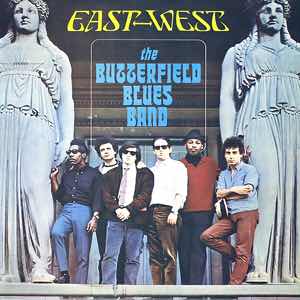
Note 2022: This review was written in the 90s and was part of the Delta Snake "Classic 60's Blues Album" series of reviews. It was republished online in 2014 and now, in 2022, edited down from its original length.
It's a special piece to me, as one of the founding members of the Butterfield Blues Band, Mark Naftalin, took an interest in the review and looked over early drafts. He gave me a great deal of feedback and backstories, which increased my insight into the album, and my conversations with him about the album are some of my fondest memories from that time. Mark was a generous person with his time and insights.
For that reason, I've made very few edits, only where there were obvious grammar mistakes. I wanted to leave the review basically as Naftalin saw it published.
CLASSIC 60'S BLUES ALBUM REVIEW: EAST-WEST by The Butterfield Blues Band
Note: You'll notice that many songs are discussed out of order as the review unfolds. The reason is that I wanted the review to follow the flow of my discussion and because the most influential changes often come from particular songs, not entire albums.
I owe a lot of thanks to one of the founding members, Mark Naftalin. He looked at the early drafts and offered many critical and helpful comments about the text. But, of course, the final opinions are my own and don't necessarily reflect Mark's view of this classic recording.
The Paul Butterfield Blues Band's "East-West" recording is one of the most important 60's era records, particularly in its effect on other musicians.
Given Mike Bloomfield's charisma at the time, particularly after their work with Dylan, they could have become rock stars. As it was, many later guitar greats like Carlos Santana (who stated it in an interview) admired Bloomfield, who was probably the first of the 60s American "Guitar Heroes," and as a side note, one of the guitarists who popularized the use of the Gibson Les Paul in rock.
Instead, the Band moved into more intricate jazz and modal territory, with at least one step into popular rock. It wasn't a sound that evolved in the often insular blues world. Instead, it was as much a part of The Times as the San Francisco psychedelic bands and, in many ways, predated and anticipated what happened later in the 60s.
Their awareness of the outside world differentiated them from all of the young blues bands of the day. Instead, the Butterfield Blues Band took the blues and related to the music as younger musicians aware of rock and jazz would have. The East-West record clearly shows a band aware of modal scales, jazz of all types, New Orleans R&B, and rock.
One change was Sam Lay's replacement on drums, a genius of a drummer named Billy Davenport. While Sam's work on the first album was superb, Davenport had a flexibility that could only come from a drummer who understood rhythm as a "pulse," providing propulsion as opposed to a beat, very much in the jazz sense.
It may be a digression, but it's interesting to briefly look over what happened in 1966 when East-West came out. Folk-rock was becoming big, the Jefferson Airplane was a harmony folk-rock band, the Beach Boys and the Byrds were beginning their periods of adventuresome work, and Miles Davis was Exploring modal-based jazz that seemed more straightforward on the surface but had a concept of space and time that became highly influential. The Beatles and Stones were turning everyone's idea of what a rock group was upside down.
The English Blues scene was splitting into a traditional faction exemplified by early Fleetwood Mac and John Mayall and an experimental one typified by the Yardbirds. By the late '60s, many of the above trends and ideas had merged...long improvisational jams based on interpretations of Coltrane, Miles, Sitar music, and other influences could be heard everywhere. Music seemed more "serious" but freer.
But back in 1966, there was "East-West." As you listen to the title cut, "East-West," and follow the changes in dynamics over its 13-minute length, one realizes that this work was visionary. One can see the entire gamut of jazz, modalisms, and even San Francisco psychedelic.
I've begun discussing what was the album closer first, but we do have the advantage of hindsight, and that cut did become the most famous and influential. The title cut was also a microcosm of the changes in the Band's sound. Gone was the straight-ahead attack of the first release. In its place was a complexity that wasn't always apparent on the surface. A careful listen will reveal a complex jazz-like undercurrent. It had a rhythm track that could have accommodated a multitude of ideas and tonalities. Instead, it made the various improvisations that followed work like a seamless flow of related ideas.
Elvin Bishop took the first solo and opened with the fieriest of the improvisations. Although not as technically adept as Bloomfield, his solo was more aggressive. His ideas and riffs were more straightforward, with a lot of attack, and on the surface, could strike the listener as showing less understanding of the modal concepts being explored. One thing is obvious...his solo works well as pure sound. The distorted riffs had tonal ideas that wouldn't have been out of place on an early 70's jazz-rock album. Although Bishop's solo is rooted in rock and blues, it still sounds fresh, and more so today.
At the time, Bloomfield's work tended to get the most attention, but to these ears, Bishop's work was just as integral to the arrangement's success. It is hard to quantify and put into words, but the best way to say it is that it is his energy that draws you into the song.
Butterfield's harp solo comes next, and he amplifies the sonic attack with which Bishop opened the song. The harp tone is aggressive, and as it unfolds, it comes across as a series of sharp, rapid ideas. At times, the music would seem to call for a fast flurry of notes (as in a traditional blues solo). Still, he would reverse practice and follow a trail upwards, then explore the tonal microtones and subtleties of a particular note or chord.
One could imagine that Butterfield may have shared a closer bond with Bishop than with Bloomfield (Bishop being the original guitarist in the Band). It shows in the music. The two solos sound as if they were built from the same mindset.
Bloomfield comes in next, and his cleaner tone and rapid-fire ideas are an ideal change in dynamics. His solo builds impressively, and the modal explorations show us a guitarist who seems exhilarated at discovering and exploring new and freer territory. Bishop's guitar comes back in, and the two build up to a peak that once again becomes almost pure tone and sound. One would be hard-pressed to find a better example of such pure sonic beauty, all the more remarkable for being created in 1966 by what was known as a blues band.The peak then subsides, and the rest of the song builds from a series of ideas that, at least on record, anticipate the "spacy jams" of the San Francisco bands.
One other significant departure in the group sound was not of the intellectual or theoretical variety. For whatever reason, the Band also covered a song by Mike Nesmith was, at the time, a member of the famous pop group the Monkees. The Band wasn't aware of this as the song was submitted to them by the publisher in the usual way songs are looked at and evaluated for a new album in demo form.
Anyway...the song was "Mary, Mary," which many rock critics considered a good one. It is a remarkable and successful rock-blues experiment that still sounds as good as any modern blues artist has done since. The arrangement, originally a riff-song in its pop form, is done here as a darker piece, using a heavier guitar opening with harp and piano counterpoint. It was an arrangement that owes much of its success to Naftalin, an excellent keyboardist.
The other extended number on the record is "Work Song," which shows a jazz sensibility in the sound. It covers a wide range of approaches, which include the theme played in stop time, a succession of solos with ever more intricate and wild overlaps, and rhythm breaks on the downbeat of the final theme. It flows a lot better than I describe it. Bloomfield's use of the telecaster as a jazzy guitar in this song is something I wish other musicians would do more often. His solo builds and climaxes with octave runs, which in 1966 was a rare technical effect in the blues. If you love Albert Collin's "Highway is Like A Woman," you'll understand what I'm talking about.
Naftalin contributes organ work that is both adept and beautifully conceived. One interesting aspect is that he uses a lighter, cooler tone than the funkier Hammond sound of the day. It may not have come across as powerful as a Jimmy Smith number on the Hammond organ, but the more relaxed tone sounds more modern and hasn't dated.
Bishop's solo is the final one. It's interesting to hear him here and in later cuts, as it contrasts strongly with the Southern and Goodtime rock and roll he later did in the 70s (with considerable success, I might add).
One of the most robust jazz-flavored songs, yet firmly rooted in blues, is "Two Trains Running." It opens with a unison riff, hard bop style, and the shuffle rhythm that follows moves forward with an energy that reminds me of Art Blakey or Cannonball Adderly (who did some pretty fine blues also when he was in the mood).
PAUL BUTTERFIELD BLUES BAND (FIRST ALBUM)

The record opens with the Robert Johnson classic "Walkin' Blues" and features the arrangement that became one of the definitive versions. Nowadays, most rock and blue bands use that same march rhythm that drives the cut along. Perhaps this version isn't as well known as Elmore's "Dust My Broom arrangement," but Johnson was rarely covered better.
Next comes "Get Out Of My Life, Woman," performed about as flawlessly as you can. Most versions go hard on the rhythm and use a hard funk approach. In this case, the Band decided to lay back a touch, and the result is dramatic for such a small change. Davenport and Arnold's work is superb. Laying back on the rhythm made it an ideal keyboard song, and Naftalin's work here is the backbone of the arrangement. His right-hand work interacts with the rhythm section perfectly, and his fills and melody give the music a sophistication that will appeal to a modern listener even today.
"I've Got A Mind To Give Up Living" is a slow blues, done ballad style. Paul sings with great power and a natural sense of emotion that makes it classic. A cut that still sounds great now. Also, the way the piano and guitars interact and combine to create a single chord at some points is impressive. "All These Blues" turns the tempo up and is a chugging style of blues. Like the song before, the keyboards and guitars are used as an ad-hoc horn section. Butterfield's harp solo cuts through and combines with vocals in a call-and-response manner. Each musical phrase sounds perfect and focused.
"Work Song," Mary, Mary," and "Two Trains Running" follow and have already been discussed in detail.
Next up is "Never Say No." It's called (by its author Percy Mayfield) "Never Say Naw." It's a quiet number in the "Tin Pan Alley" mold, but done like, say, Mose Allison would have done it. The general mood is atmospheric, and the Band's playing is understated. It should also be noted that this was Elvin's first recorded vocal and a fine debut.
The set ends with "East-West," and its placement is ideal. It's as if all the changes and subtle touches throughout the work led to this point. It's one of the greatest album-closers of all time. As time passes, I think there has been and will be an awareness that the blues underwent many changes during the '60s that were as momentous as any that occurred in the 50s. At the forefront of that change was the Butterfield Blues Band. What they did with the blues makes the Band's music so great. They chose exploration, change, and, most of all, the idea that the blues was an expression of the times.
In this, they were akin to the great explorers in the jazz scene.
- Al Handa
May 2014