

 |
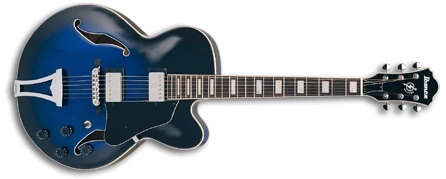
Review And Essay: 2002 Ibanez Artcore AF-75 - A Hollow Body For The Masses
One of the things about Earth shaking events is that people will remember what they were doing at the exact moment it happened.
Please note that I’m exaggerating a bit…
In 2002, there was an event that I definitely remember what I was doing the day before and when this event occurred. It may not have been earth-shaking to everybody on earth, but it certainly was to any guitar player who wanted an inexpensive hollow body. I'm not talking about semi-solids, or double cut ES type guitars; I'm talking about what was considered a hollow body or jazz guitar back in 2002.
Back then, that type of guitar was considered esoteric and exotic, for lack of a better word, and the closest one could come to getting an inexpensive hollow body was maybe finding a used Harmony Rocket, a single pickup type, for around 250 and you had to accept the fact it it probably had a bad neck. You could also get an acoustic archtop of varying quality, and then mount a pickup on it, but I think you get the picture.
In 2026, the picture is different, you can get a new hollow body all day from 200.00 on up and used at all price ranges.
Here’s a list of 2002 street prices if you wanted to get something that resembled a “jazz” guitar. They included some semi-solids but it wasn't a very large market.
Epi Dot - 400.00
Epi Joe Pass II - 600.00
Epi Sheraton II - 600.00
Used Harmony Rocket 250-500.00
Guild - 1800-2200.00
Gibson ES-333 - 1200.00
Gibson ES-135 - 1100.00
It's not a comprehensive list, it's just to give you an idea of the price range. The low-cost models you see there were the most common found in the San Francisco Bay area, which is where I lived at the time. This region has never had a guitar shortage and any guitar debut campaign included several of the stores here.
Now, as far as what I was doing in 2002 before this explosive event; the night before I was talking with a musician friend and just happened to be looking at her guitar collection and noticed a used Harmony rocket which she said cost $180. It was a single pickup type, with the DeArmond pickup, the action was borderline playable and at the time, I remember it seeming like a real bargain, a stroke of luck. In those days you had to think in terms of getting a used semi-solid Joe Pass, which wasn't usually available at a good price, but it was the closest you could get in many ways.
The next day I happened to be wandering through a guitar store (real guitar players do that sort of aimless thing) I'd been frequenting for several years, starting when they sold guitars out of a garage (and I had traded an ES 330 for that Gibson country and western that I have mentioned in past blogs).
Well, this was 2002, and they were a much bigger store and I was a regular customer for supplies and an occasional guitar. Sitting there in its own aisle section was a whole line of new Ibanez hollow body guitars. What caught my eye was the transparent blue sunburst AF75 with a street price of $320. Since I was a regular customer, they quoted the lowest average street price which is about $300 which included case and free strings. So, I spent the last of the credit in my card and became the proud owner of a new hollow body.
It may seem like an exaggeration but the fact that those Ibanezes came out brand new, costing what would have been normally a used price, for an inexpensive playable hollow body was quite an event. I read articles that week that said that certain big manufacturers quietly asked Ibanez how they managed to sell Jazz guitars at that price point and as it turned out, we were seeing the start of a big run of cheap Asian guitars, this time from China.
In terms of actual playability, the AF75 was very well set up right from the start. I used the guitar in a couple of rehearsals and found it to be an excellent player, the main problem being that the pickups could get you a decent Jazz sound but nothing exciting. The pickup sound was fat and warm but didn’t have that acoustic clarity, that big box sound. That was surprising as the AF75 had a maple body, so it should have sounded a little woodier.
I could tell that there was a great deal of excitement over the guitar line because after my excitement faded after a couple weeks, the guitar sold for $280, which was only about $20 less than I paid for it. The guitar at the time was selling very well and was often out of stock at music stores, so when I put mine up for sale, several bids immediately came in and it sold that day. That also was something that made that time in 2002 memorable.
In a way that AF75 killed my interest in hollow body jazz guitars. I think that when you can't get one, the things can seem almost mythical, with imagined capabilities that fade once reality sets in, that is to say, actually owning the object of my desire was less exciting than the fantasy.
Once hollow bodies became a commodity, well, some of us decided that maybe the jazz guitar wasn't versatile enough or whatever. In my case it was back to my telecasters. However, I was always impressed by what Ibanez did that year, which was they made an entire category of guitar easily attainable for any guitar player who wanted one.
One other time I can think of when an inexpensive line really shook up the market was maybe the so-called “lawsuit era.” I'm sure historians can cite other markets where this happened but the idea that you could get a range of imported guitars that were at least perceived to be as good as Gibson and Fenders, reinforced by the fact that lawsuits were filed over it, was as close to Earth shaking as you could think of in that particular world.
One equivalent event was in the Banjo world when entry level banjos were almost all the aluminum rim types that experts and cork sniffers bad mouthed and after a series of events, that market expanded to a point where a decent banjo came be had at almost every price range. I'll be talking a bit about that in a future “Review & Essay” about the Washburn B-10 and the Deering Goodtime banjos.
So in 2002, as much as one company could, Ibanez did shake up a segment of the market and the resultant competition produced a range of hollow bodies that a player could get in every price range. The category didn't explode because those guitars were always going to be a smaller market, but the commoditization did mean that a lot more people were able to get one, particularly the rockabilly and roots music people.
If you can easily get a hollow body guitar in 2026, you can credit Ibanez for what they did in 2002. It wasn’t about creating demand, it was about providing more choice.
Al Handa
July 29, 2026
AF75 Specs (partial)
Full-hollow archtop Laminated maple top with ƒ holes and ivory multi-binding
Maple back and sides with a Single Venetian cutaway Set mahogany neck
20-fret rosewood fingerboard with ivory binding and pearl block position markers.
Two humbucking pickups
Individual volume and tone controls
Tune-o-matic style bridge on a wooden base
Trapeze tailpiece
Plastic nut
Black pickguard, speed knobs, and Ibanez tuning machines.
The first blue finish options for the Ibanez Artcore hollow-body series—specifically Transparent Blue
 |
 |
 |
 |
 |
 |
 |
 |
 |
 |

