The Delta Snake Review

The Delta Snake Review

Translate

Showing posts with label epiphone. Show all posts

Wednesday, July 22, 2026

Aftermarket Review: 2024 Epiphone Power Player SG


Aftermarket Review: 2024 Epiphone Power Player SG

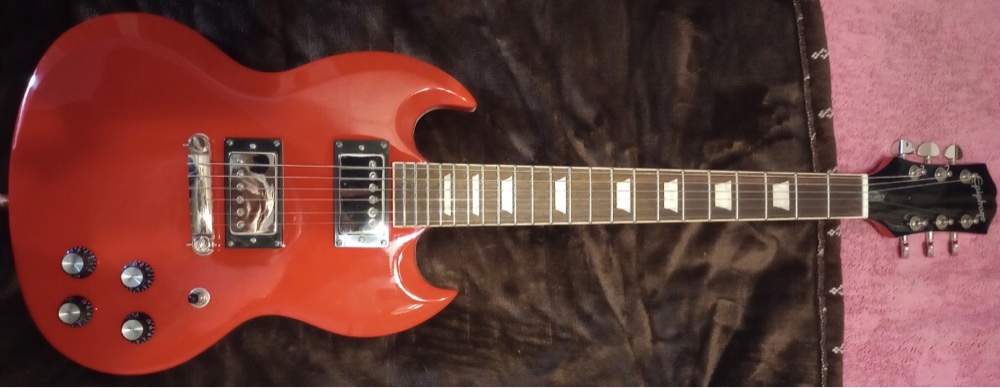
The Epiphone Power Players SG is a 3/4 size electric with a 22 fret, 22.73” scale and a slim profile D bolt-on neck. The SG has a 650R neck humbucker and a 700T bridge. The Power Player SG was introduced in 2022 and is still being manufactured. So, obviously this is a guitar that has already been extensively reviewed on YouTube and the web. I’m reviewing it here since I’ve had a recent experience with it having purchased one back in December 2025. 

I’ll stress what I bought it for and you can consider this an aftermarket review about how the guitar has performed since the initial introduction and hype.

I bought it because I was intrigued by the idea of getting an SG that had a shorter scale and no neck dive; I figured the shorter scale one would do the trick. That turned out to be true. It’s a nicely balanced, quality guitar that has the solid feel of a full size. I’m not sure about it being a good travel guitar; the  ¾ length is, in my opinion, more suited for a car trip, etc.

After six months, the positives are that the ergonomics are very good, a very comfortable guitar to play. The pickups are good enough to keep on the guitar as opposed to needing to be upgraded.

As far as it being an SG, or more specifically, sounding like one, that is a little difficult to quantify. The earliest SGs had P90 pickups and the next generation with humbuckers sounded different than ones I personally heard later. In other words, you can’t really say that this SG has “the classic sound.”  Any model that's been around for over 50 years is likely to have quite a few variations. Telecasters and other Fenders are in a similar situation; there is no one classic sound anymore.

As I’ve said in other blog entries, there are certain types of superlatives and descriptions that don’t really tell the reader what the guitar sounds like. It’s best to simply refer everybody to YouTube or elsewhere on music sites to actually hear the sound of a particular model. 

One thing I can do is give you an immediate comparison, or at least the one I noticed, and that's that this particular Epiphone is similar in sound to the Les Paul version. The pick ups are quite good, clear and very articulate, both in clean and high gain. 

As we all know the louder the guitar gets the more similar it becomes to other guitars at the same volume level. In this case, my impression is that the sound is more along the lines of what they get in this price range with the Les Paul copies. If you want a sound that's closer to a Gibson SG, I would recommend getting one of the excellent G series models. Also, If you have a particular sound in your head, then definitely try both the P90 and humbucker versions.

In the case of the Power SG, there’s a lot to like about it as a beginner guitar, travel guitar or a second or third in one’s collection. The guitar has excellent pick ups, and sounds versatile enough to cover quite a few different genres. It’s not quite a time machine in the sense that it can reproduce some of the classic 60s sounds, but that’s an esoteric application in 2026. For a lot of players, the type of music they want to play developed a lot later in the 70s onwards.

In terms of the SG sound I was looking for, I went ahead and just stuck with the IYV (reviewed in this blog) because after sitting with it for a few months, I realized that the neck length and any tendency to dive doesn’t really matter that much when you’re sitting down. 

The type of sound you get with a full size SG due to the neck length, etc, isn’t going to be present in a short scale version. In fact, the P90 version of the Epi Les Paul Special 1 has more of the sound I was looking for along with the IYV.

As far as any recommendation, it may not have been what I was looking for, but it has plenty of virtues for those who want to use it as an entry level guitar and beyond.

Al Handa

July 22, 2026
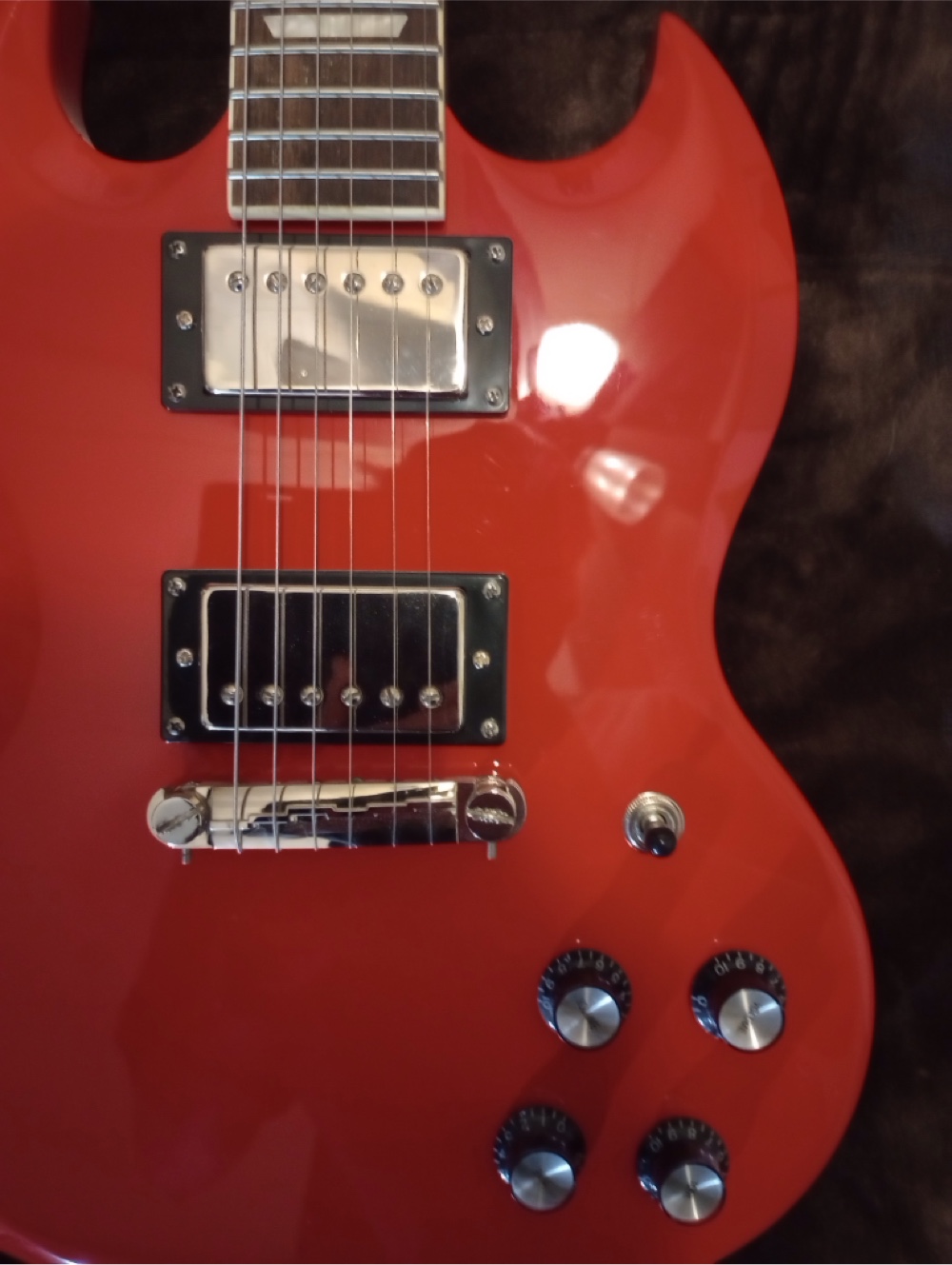


Specs


Binding. Single-ply, Fretboard

Body Finish  Gloss

Body Material  Mahogany

Body Shape  SG

Body Styles. SG


Fingerboard Material  Laurel

Fingerboard Radius  304.8mm / 12.0in

Fret Count  22

Frets  Medium Jumbo

Inlays  Pearloid Trapezoid

Joint  Bolt-on with Sculpted Heel and Ferrule Inserts

Neck Material  Mahogany

Nut Material

White Plastic  Nut Width

41.0mm / 1.61in

Profile  SlimTaper D

Scale Length  22.73in


Bridge Pickup  Epiphone 700T Humbucker

Controls  2 Volume, 2 Tone

Neck Pickup  Epiphone 650R Humbucker

Lightning Bar Compensated Wrap Around

Nickel Tuning Machines

Die Cast with Kidney Buttons



Monday, January 20, 2025

Review: 2024 Harley Benton RB-600CS

Review: 2024 Harley Benton RB-600CS

I believe most guitar players have already seen this guitar on YouTube, either in reviews or infomercial-type videos. What caught my eye was that it was one of those rare guitars with Rickenbacker-type styling that hadn't been forced off the market by that company, which is well-known for defending its trademark and design.

The Harley Benton is one of two that I've seen; there is an even cheaper model by another company with the same Rickenbacker-type sunburst and pickguard and a similar headstock.

I hesitate to call this new wave of guitars in the 100-300 dollar bracket purely cheap; most are probably from Chinese companies left by the major guitar makers moving on to Indonesia or Vietnam.There was certainly a lot of attention on the inexpensive ones in the $100 range because a lot of guitar knowledge is actually word of mouth and not actual experience, but the generally rough fit and finish of those models are often seen as standard for even those guitars that are up in the  $300-400 range.

The 2024 Harley Benton RB-600CS is closer to the lower-line Gretsch or Squier entry-level guitar range. It is probably made by the same factory in some cases. 

One other feature common to the two Rickenbacker-influenced guitars, as they're not truly clones, is the use of mini-humbuckers, which resemble the pickups used on Rickenbacker. As I said earlier, that resemblance did attract my eye, and if that's all there was, I'd have just moved on because, in my entire life of GAS, I've never owned a Rickenbacker.

I've had close contact with one, as one of my guitar friends owned one for over a decade, and I heard it constantly during rehearsal. The main problem for me was that it had a particular sound I didn't use much, which could be duplicated by other guitars in my collection. I wasn't a big fan of the design, particularly the cutaway style.

If you were to remove the sunburst finish, then the primary resemblance would be the pickguard. There is some similarity with the pickups, but any close examination would see that they're not that similar. In fact, there's more of a similarity to a PRS SE or other guitar in that style than with the Traditional Rickenbacker.

I took a chance on the Harley Benton because I happened to be looking to add a few inexpensive guitars for some future recording projects. Due to my age and the condition of my hands, one requirement was a shorter-scale guitar that was light and, in terms of sound, one with mini-humbuckers. In terms of sound, this isn't a guitar you should buy to get a Rickenbacker on the cheap. It sounds closer to some older Gibsons and Epiphones that had mini-humbuckers, though you can probably get some jangle with some fiddling with your amp.

What you do get, and this is based on my own experience with this particular guitar, and I certainly can't speak for the entire line in terms of quality, is a guitar that arrived without needing a major setup. The fit and finish were more than adequate, and the short scale and lightness make it an extremely easy and fun guitar to play. It has the same feel as an Epiphone Casino but with nice ergonomics (Casinos feel awkward to me) As far as an entry-level guitar, it's as good as any.

One interesting feature is a cover over the bridge, kind of like telecasters but thinner. It only covers the bridge. That’s more common with Resonators and in my case, useful as a palm rest for doing finger style but it also prevents you from being able to use your palm to mute the bridge, which would turn off a lot of country players.

The stock pickups are pretty good, and I wouldn't recommend replacing them immediately until you've played the guitar for a month or two. You might decide to keep it in stock as the RB has a classic mini-humbucker sound, which could be described as being between a single coil and a humbucker. In terms of sound, one could say that it has a pleasant and clear, clean tone that a good player can dirty up without cranking up the amp. In other words, the mini-humbucker is a pickup that responds well to touch.

You can get a closer view of the actual sound in this day and age by going to YouTube and hearing one of the many demos. One of the things I always do when checking out demos on a particular model guitar on that site is to listen to both expert players and beginners. It gives me a better idea of what the guitar sounds like and what you can bring out through technique. You might find that the basic tone can be duplicated by a guitar that's already in your collection.

I would recommend the Harley Benton to beginners, intermediates, and those who want to add an extra guitar to their collection without spending a lot of money. I should note that there's also a 12-string version, though I have no personal experience with it.

The average price is in the $300+ range, which also includes taxes and shipping. You can take the remarks about guitars in this range as being too cheap to have any level of quality with a grain of salt because it's mainly in America and other Western countries that a $300 guitar can be considered beneath the level of an experienced musician (or cork sniffer).

You'll get a very decent level of quality with this guitar, easily as good as a Squier or a lower-line Epiphone. As I said earlier, I'm speaking from my own experience with this particular guitar. It arrived without needing anything more than a very slight adjustment of the neck and a partial lowering of the bridge. The frets were fine, and there was no buzzing when I dropped the action even lower.

The Harley Benton is a light, easy-to-play guitar that will be a fine first guitar or an additional one in any collection. Just remember: It may have some superficial resemblance to a Rickenbacker, but in terms of sound, that's not what you're going to get.

- Al Handa
  Jan 2025


Please check out and listen to my music on Spotify, YouTube, Apple Music and other music sites. Please add any cuts you like to your playlists!

Saturday, May 18, 2024

Review: 2013 Gibson Hound Dog Dobro

Review: 2013 Gibson Hound Dog Dobro

The Gibson Hound Dog is intended to be a starter dobro for the beginner, although at around 1300.00 street price it may not seem like it. To understand the price, you have to understand the history of the Hound Dog. 

Back in the 1920s, a distant ancestor of this guitar was manufactured by the Original Musical Instrument Company, founded by the Dopyera family, inventors of the Dobro in 1928. Back then, it was, and still is, a fierce competitor to the National Resophonic company, which made the now legendary metal-bodied guitars. 

Back then, the “Dobro” wasn't a generic term. You had a Dobro, or a Resophonic (National), and it virtually always meant a product from the respective companies. The Dobro was intended to be a high-quality, but lower-cost alternative to the National. 

Essentially, a Dobro is like a National, with its sound produced by an aluminum cone that vibrates and amplifies sound, but with a wood body. The combination of resophonic type volume, warmer sound due to the wood body, and its lower cost made the Dobro a staple in the Bluegrass and Country genres. 

That same warmer, almost slinky sound, made it less of a force in Blues and Hawaiian slide music. However, players from all genres used Dobros if that's what they could afford or preferred. Like all slide-oriented guitars, it came in a square or round-neck configuration. The square necks were exactly that. Guitars with square-shaped, heavy necks that were intended to be played on your lap, or face up. 

Roundnecks were played pretty much like regular guitars. Gibson bought out the company in 1993 and moved production to Nashville in 1998 and added the Dobro, to the mandolin and banjo lines into what they called their new Original Acoustic Instruments division.

The Hound Dog is a direct descendant of the old Dobros but sports some modern touches. The round neck has Fishman electronics and a radiused fretboard. The neck is relatively short, like most old Dobros (and Gibsons for that matter), but the new rounded fretboard does force the player to make a choice. Keep the action low, but have a harder time executing full chords with the slide, or raise string height and have your bass and treble strings further away (and harder to fret).

Old slide guitars generally had flat fretboards for that reason. Adding a radius just adds cost, really. The best compromise is to adjust the nut so that the strings are lower in the first position, and let the action run high from there to the bridge for slide work. In my case, I tend to adjust it down for finger-style playing and use a lighter glass slide (giving up some tone in the process). Keep in mind we're talking about the round neck here.

Some players will find the Fishman's lack of tone and volume controls annoying. One can adjust it at the amp (and most guitars sound better that way) but it can be a dealbreaker for many. The Hound Dog is an acoustic though, and its pickup system isn't out of line with the way most pickups for that kind of guitar function.

It's an attractive guitar, with clean lines. It has a figured, and laminated maple top, which helps reduce feedback. Also, for those not familiar with Dobros and Nationals, body resonance is virtually irrelevant. The sound is made at the cone and spider bridge, the body material mainly needs to be rigid and provide a good sound chamber.

That's why you can replace the stock cones in a cheaper dobro-type guitar with a high-quality one, and transform it into a passable pro-quality guitar. You can pay for higher quality wood, but after a point, it's mainly for looks. There'll be those who'll disagree, but my point is essentially the truth.

Getting back to it's price. Its Epiphone equivalent is the Biscuit, named after its biscuit-style bridge (a simple slab of wood). If you compare the two, there's a noticeable difference in wood quality in terms of appearance, but the mahogany Biscuit is a bit warmer, especially if you change out the cone.

Where the Hound Dog is better is in the volume department. Its tone is brighter and projects well. It clearly has a better-quality aluminum cone that's thinner and better machined. This translates to a better slide sound in the genres it's made for, Bluegrass and Country. The Biscuit has a sound better suited for folk blues, Hawaiian, and fingerpicking.

The other noticeable difference is that the Biscuit is around 350.00. Add a 75.00 cone upgrade, and you have 90% of the Hound Dog in terms of sound. Obviously the latter is wired for sound, has better hardware, etc., but as a starter, it's for those who want the name. This is an ideal guitar to find used.

It's 1300.00 or so price tag is quite competitive with the average National Resophonic guitar, which averages 2500.00, and it's a price battle that's been going on since the '20s. 

However, both styles of resonators have been targeted by a lot of companies determined to sell lower-cost versions. The early ones were mediocre, but lately, companies like Saga (who bought the classic Regal name) are dominating the starter category with models in the 400.00 range. 

Many of them, particularly the Regal, become excellent guitars when the cone is upgraded. It becomes harder to tell the difference between brands also, because of all the types of acoustic instruments, resonator-type guitars are the most dependent on who's playing it (well, maybe except for the banjo). You can take a 2500.00 National, and easily make it sound like a 350.00 Johnson without breaking a sweat. That's the key element for a guitar that was designed first to be loud above all else. 

The original intent of both guitars was to provide affordable (though pricier than regular acoustics), tough, and very loud instruments that could stand up to extensive playing in rough establishments. Their competition up to the sale of Dobro to Gibson was fierce and at times marked by lawsuits.

The Gibson Hound Dog in a sense has ended that fight. National is now a boutique manufacturer that can't duke it out with a company like Gibson. Gibson in turn, has created a Dobro without the pressure of competition. It's been modernized and given a Gibson pricetag for a guitar that's been crafted with its philosophy of using good woods and expert workmanship. None of these will influence the sound much unless the cone is good, and the Hound Dog has a decent but not an excellent one.

The cone is the secret of any good Dobro, and now everyone who makes one knows that, and manufactures cheaper resonator-type guitars knowing that many buyers will simply change out the cone or not even know the sound difference. 

The Hound Dog is a pretty good dobro. If you get one, you'll like it. However, due to its price, you'll like it even better if someone gives you one for Christmas. If you're using your own money, make sure to play it alongside an Epiphone Biscuit first. 

The competition between the Dobro and National was both epic and beneficial. This is one case where I'm sorry that one side finally won. 

-Al Handa
 2013

Note: This review first appeared on the ePinions.com site in 2013. This and other reviews were short takes that accompanied the link to a business that sold the guitar. As a rule, the guitar had to be at least examined and played by the reviewer (and ideally owned). In my case, a severe case of GAS made it possible to have at least owned the reviewed instrument for a short while. I'm reprinting these as having another source on a guitar never hurts, even if the reviews aren't definitive. Other than minor corrections, these short takes are unchanged from the original text. I figure that it might be helpful to keep the older perspective.

 Also by Al Handa:

Please check out and listen to my music on Spotify, YouTube, Apple Music and other music sites. Please add any cuts you like to your playlists!


Podcast Episode 3 now live on Spotify and Apple. 


https://podcasters.spotify.com/pod/show/alhanda/episodes/On-The-Road-With-Al--Ivy-Episode-3-e2k5k0q

Topics:

The Godfather by Mario Puzo, Three Musketeers by Dumas, and the Robin Hood myth.

Some thoughts on Travels With Charley by John Steinbeck, On The Road by Kerouac Scroll Version, and The Road by Jack London.

Music:

My Dog Dreams And Becomes A Mermaid Techno Mix, Sunday's Moon and Nigel Raga by Handa-McGraw International.

Taylor's Blues by Mark McGraw


Sunday, May 5, 2024

Review: 2013 Gibson Faded SG Special

Review: 2013 Gibson Faded SG Special

With the faded SG Special, we have that odd situation that Gibson and Epiphone seem to get into every few years. Which is that their mid-price products clash and are in open competition.

The most famous instance is the Epiphone Casino, which was essentially a Gibson ES-330 body (but with P90s) but the latter model faded while John Lennon rocketed the Casino into a clear victory for the economy model (at least at that time). 

At this time, you can get a faded Gibson SG for around 570.00, and the Epiphone 400 model has dropped to as low as 299.00 (a very good deal also, it's an underrated guitar). This can create some confusion, as about the only thing you can do to an SG is change its color. If it's any other wood than mahogany, it's not an SG, period.

So what Gibson has done is produce an SG that saves you the trouble of buying the Epiphone, and buying good pickups for it.  Also, I'm sure Gibson's a little tired of seeing all those competitor SGs and Flying copies selling well at the 400-500 price point.

This particular SG is not the classic configuration. This one is like a special version of the Les Paul. The pickups are standard Gibson 490s, which are more midrangy and dirty than the classic '57s (which are like the Seymour Duncan Seth Lover for another example). There are two camps on this now classic pickup, one hating it, the other liking it. 

Personally, I think on any Les Paul Special, faded SG, or any pure mahogany guitar, the 490s are a very good fit. The rear pickup is pretty hot and sharp, yet thick sounding, and the front gives you anything from a classic hard rock sound like AC/DC, or a little on the jazzy/blues side).

Remember, Muddy Waters' first guitar player used an SG (in case you don't know, it was Buddy Guy). Guitars at this level, which have the same standard pickups that the company puts on its high-end stuff, should frankly be bought that way as a package. 

If you don't like the pickups, you shouldn't buy the guitar (used or at a close-out price, that's a different situation). The reason? You're going to just add another 200.00-300.00 (if you install the things yourself) to the price. Put that 300.00 with the 579.00 and tax and buy an SG Standard.

Or, even if it gives you a guitar that others think is lame, upgrade to an Epi SG and it'll cost a bit less. Since the 400 model has dropped to 299.99 (due to the Faded coming into the market I imagine) it's a feasible idea. 

The faded Gibsons are often a mixed bag, but the lowest-priced ones are as good a deal as any. It's a mid-priced package that emphasizes the key parts of the guitar, the neck, and pickups. The Walnut finish in particular actually has the advantage of looking vintage also.

At 579.00, it's as good as you'll get with Gibson. A decent mahogany guitar, their top-line pickups and a nice neck and fretboard. Also, as we all know, even the cheap Gibsons keep their value better than a lot of other brands, including Epiphones.

So instead of an Epiphone or Agile Les Paul copy, buy a faded SG, and let that Gibson magic rub off on you which is now at a price for the masses.

- Al Handa
  2013

Note: This review first appeared on the ePinions.com site in 2013. This and other reviews were short takes that accompanied the link to a business that sold the guitar. As a rule, the guitar had to be at least examined and played by the reviewer (and ideally owned). In my case, a severe case of GAS made it possible to have at least owned the reviewed instrument for a short while. I'm reprinting these as having another source on a guitar never hurts, even if the reviews aren't definitive. Other than minor corrections, these short takes are unchanged from the original text. I figure that it might be helpful to keep the older perspective.


 Also by Al Handa:


Friday, May 3, 2024

Review: Epiphone Special Edition PR-5-E Cutaway Acoustic

Review: Epiphone Special Edition PR-5-E Cutaway Acoustic 

I'm reviewing a PR-5-E that is a Custom Shop Special that's part of the Epiphone “Guitar of the Month” program. Each of those special editions is really just the stock guitar but comes with one “special” extra feature.

In this case, my PR-5 comes in an attractive Alpine white finish with the usual gold hardware. As I describe this guitar, other aspects may come out that are different than the regular model. Epiphone has made one thing clear about the “Guitar Of The Month” series, which is that the pricing will be affordable (rare with Special Editions). 

In this case, the guitar was manufactured in China, which I imagine kept the price down at its usual 299.99 internet price. This will probably bring about the usual disdain from some guitar snobs, and frankly, it did from me also, but this guitar sold me on its merits.

Among those include a solid spruce top, mahogany body and neck, and excellent Grover tuners. Action at the nut was excellent, and while the action was high towards the bridge, it was easily adjusted with a little sandpaper. I'm a big fan of mahogany guitars, you get the warmest sound from guitars made from that wood.

I have heard and read, however, complaints that this is a “quiet” guitar. The key thing to keep in mind is that Epiphones (and many Gibsons for that matter) are not Martins, or even Seagulls, etc. Historically, those guitars have always had a quieter, silker tone. 

The thing to remember is that aesthetic judgment, even by experts, is mainly a matter of taste. I'll trade volume for tone any day.

Even the famous Gibson Hummingbird for all its size isn't as loud as a big Martin. By the same token, the sound is more versatile. Being an acoustic/electric, the price can be kept down as it doesn't have to be built to compete with a more acoustic-only model. Also, one thing I can add, this model is as light as any high-quality brand I've tried (remember, fragility is often a side product of quality in acoustics).

Any acoustic/electric played alongside an equivalent-priced acoustic-only guitar will sound flat or quieter...period. No contest.

Two reasons: One, the cutaway (that sells the guitar in most cases) imposes restrictions on the bracing and sound qualities of the box (which an acoustic guitar is), and two, this type is designed to hit hardest in the midrange. This style was designed originally for stage work where a guitar with a boomy bass or extreme highs sounded lousy on stage or the tone had to be compressed in the studio (and of course, to improve access to the upper frets).

The major player that essentially created this market was Ovation, and its “thinner” sound characteristics made it a superb stage guitar, especially in large halls. From there, it wasn't a big leap to cut away acoustic/electrics built to reduce feedback.

When considering an acoustic/electric, that's the basic lineage to be aware of, and the sound theory you're hearing and considering buying.

That, and “looks” of course. Curaways do look cool. Any honest player will have to admit that any guitar has to have at least some “mojo” and have a look and feel that makes playing it a pleasure. Also, many can overlook less volume because they play at home, or only use it live once in a while in smaller venues. Those who do regularly use it live give up some frequency response so their guitars won't sound tinny or muddy from a boomy bass.

At 300.00 this particular guitar is a fine value. The fretwork is impeccable, running your fingers along the neck shows no rough edges and no uneven frets. The thin neck is as fast playing as you can get for an acoustic.

The acoustic sound is good, use 10's or 11's and you get a wonderful chiming or twang, use 12s and you get a thicker, almost jazzier tone. The body is wide, but the box is thinner, so ergonomically, it's quite comfortable to play. The curves are in the right place, so it fits against the body nicely. It's not a high-volume guitar, but it's got a good tone, and that's where the electrics come in.

It has an Epiphone Dark Shadow 4-band EQ system. You can tell its emphasis by the fact that two of the bands are dedicated to the midrange. The bass does come alive when amplified, and it has a fine electronic sound. I've heard a lot of opinions about this system, but I've had no problems with it, and I like the 4-band system. It would have been nice to have a Fishman EQ though.

Also, put a little extra gain on it (below feedback level) and it's a surprisingly good blues/Hawaiian slide guitar. Just for fun I cranked it up a bit (and stood clear of the amp) and got a bit of the Elmore James/George Thorogood sound. Since I'm using 12s, messing around with the EQ also uncovered a nice acoustic jazz sound, a la Johnny Smith or Howard Roberts, and it became obvious that this is one very nice 300.00 guitar.

The thing about acoustic guitars is that on one hand, you get what you pay for, but also, the price does or does not matter. An old Epiphone FT-130 can blow away a 500.00 Yamaha, and a new 400.00 Seagull can sound twice as expensive. It's very, very subjective.

There are some things that are sort of constant. A solid spruce top is desirable, for sound, and for a sound that gets better with age. Body wood counts, in this case, mahogany makes a warmer sound, so preference counts. Neckwood counts, a maple or walnut neck would have sharpened the sound here and maybe made this guitar less attractive to me. Bracing counts, but that's generally irrelevant in this category, the electric/acoustic type.

In the case of the Custom Shop PR-5-E, it's a case of the wood, construction, style, and price point coming together to make a guitar that was more compelling than others that were in some cases much more expensive (or similar, like a Seagull). The fact that it was made in China is irrelevant in this case, as I could only find one small flaw in the construction, and the detailed work was excellent.

I walked into the guitar store looking for an acoustic that I could eventually convert into a Howard Roberts type (this style has the same type of body), and at 300.00, the store manager had himself an easy sale.

The PR-5-E is a proven mid-priced guitar, and I strongly recommend you get the Special Edition while it's still available, it has better detail work for sure. In any case, it's a fine guitar with a unique sense of style, not one of the faceless crowd of very similar acoustics. At this price, it's a steal.

- Al Handa
  2007

Note: This review first appeared on the ePinions.com site in 2013. This and other reviews were short takes that accompanied the link to a business that sold the guitar. As a rule, the guitar had to be at least examined and played by the reviewer (and ideally owned). In my case, a severe case of GAS made it possible to have at least owned the reviewed instrument for a short while. I'm reprinting these as having another source on a guitar never hurts, even if the reviews aren't definitive. Other than minor corrections, these short takes are unchanged from the original text. I figure that it might be helpful to keep the older perspective.


Tuesday, April 23, 2024

Review: Epiphone FlameKat LE

Review: Epiphone FlameKat LE

While I was in the process of getting this guitar's cousin, the AlleyKat, this rather florid axe did catch my eye and got a cursory workout. I decided on the AlleyKat at the time, but recently have revisited getting a FlameKat or WildKat.

One reason is that used ones are finally hitting the market at a nice price, in the 300.00-400.00 range, which for what you're getting is a good deal. 
After a lengthy tryout with a prospective seller, I did have to pass, as I couldn't get past the dice and flame motif, but was surprised at how my initial impression of the guitar had changed.

This pretty successful series of semi-solids didn't come out of thin air, it's sort of a cross between some of the old Gretches and the Les Paul ES model (which I'm surprised isn't kept in at least a limited edition release by Epiphone, as it was a very nice guitar).

This particular model has a mahogany body, with a maple top and neck. Pretty much your archetype electric archtop. It of course has that hard-to-ignore flame motif, with red dice for knobs. Sort of a takeoff on the hot rod with the dice hanging on the mirror thing I guess.

The guitar also has a VibraTone Bigsby and two mini “New York” style humbuckers. It has fast-tuning chrome button-style tuners, which you'll need if you want to yank away on that tremolo bar. I've heard a lot of complaints about the guitar going out of tune when using the Bigsby, but I didn't notice it being a real problem.

The fact is, a tremolo bar will yank your guitar out of tune if it's pulled on too hard and often. Especially if you've got new strings on. If it's used in the traditional manner, to bend notes and create effects, the stress on the strings isn't that bad. If you want to be Link Wray on it, then by all means keep your chromatic tuner handy.

Another surprise was how mild the pickups could be. It has the least smooth clean tone of the three (oddly enough, the WildKat seems to be the jazziest if you want it to be), but it's strikingly jazzy. Certainly a more versatile guitar than its image suggests.

I didn't realize that the first time I tried the guitar, as the flames and dice just made me assume that it was supposed to be played at high gain. I did, and like most mini humbuckers, I found it has a high, cutting tone, but a bit smoother due to the semi-solid body style (as opposed to a solid body Firebird, which also uses minis).

Another thing that struck me was that the dice knobs may be cool, but the square shape does make it a bit harder to make fine adjustments. Takes getting used to. Also, of the three guitars in this Kat series, it has the least comfortable neck. The action and setup were fine, but the taper towards the nut felt odd, and playing on it felt slightly awkward. 

Obviously, judging a neck is a subjective thing, but it would make me advise you to try this one out before buying unless the mail-order company has a good return policy. That's if they have one, it has been discontinued, which doesn't say anything in terms of its success, it was always a limited edition model.

The interesting thing is that except for the neck and flame paint, I liked the guitar. That's probably why I ended up with an AlleyKat, which also has a mini-humbucker up front (and no tremolo bar, which is OK, I don't need one).

So, in a sense, I did like the guitar and bought it, but without the dice and flame job. Also, I think the '57 pickup that the AlleyKat has in the bridge position works better than a mini anyway.

From a sound standpoint, guitarists who will find this guitar attractive are those who play surf, vintage 50's rock, and in particular, those who want a guitar that adds some cool on a live stage. It was made to be posed with, if you know what I mean.

It can sound silky, and then ramp up into some very lively rock and roll, and in terms of performance, it's as good a guitar in its price range as any. If it was a guitar that could take off its stage makeup and put on regular clothes at home, then it'd be sitting in my closet right now with the rest of my six-string buddies.

 -Al Handa
  2006

Note: This review first appeared on the ePinions.com site in 2006. This and other reviews were short takes that accompanied the link to a business that sold the guitar. As a rule, the guitar had to be at least examined and played by the reviewer (and ideally owned). In my case, a severe case of GAS made it possible to have at least owned the reviewed instrument for a short while. I'm reprinting these as having another source on a guitar never hurts, even if the reviews aren't definitive. Other than minor corrections, these short takes are unchanged from the original text. I figure that it might be helpful to keep the older perspective.


COMING IN MAY


Tuesday, April 16, 2024

Review: Epiphone G-400 Custom SG (3 PU)

Review: Epiphone G-400 Custom SG (3 PU)

I have to admit, this was one guitar that almost triggered a major GAS attack, and on that day, I was going to buy it on sight. Luckily I didn't, although not for the reasons you might think.

It's a guitar that nowadays you can get for around 450.00 on sale in most places, and it never did replace the standard two-pickup SGs or even dent its popularity. I'm not sure why, from a distance, it's an imposing and impressive guitar. Big, mean-looking, three gold humbuckers, everything about it says turbo-charged SG.

The problem is, when you play it, it's obviously a nice guitar, but it doesn't necessarily give you a compelling reason to buy it over the traditional SG.

The traditional SG is a light guitar, easy to play (except for being neck-heavy due to its lighter body). It has a wonderful tone, warm, but biting, and it's one of the classic rock guitars. Also, it has a more unknown, but very definite presence in the classic blues. One of Muddy Waters' guitar players used an SG for example, as did one of the Blues Brothers band. 

Right off the bat, you notice the guitar's weight. The Custom is a heavier guitar, which compared to the Les Paul is nothing, but given that it's an SG model, perceptions tend to count. The neck is a good one, a bit thicker, but very playable, and the tuners are just fine.

Also, the pickups are good, but whether it's the cost of putting on three instead of two, these don't seem to be as good as Epiphone's top-of-the-line SG model. This may not be a fair comparison, as the reason you have three pickups isn't necessarily to sound like a regular SG.

The key to all three pickup guitars is the middle pickup. It can be combined with the bridge or neck pickups to give you a bigger range of tones. By itself, like most middle pickups, it's supposed to give you the most "acoustic" of all the settings.

The problem here is that the pickups are very close to one another and come close to being there just for show. I did notice some sound differentiation in the various combinations, but the louder I got, the less it showed (and let's face it, most SGs are played loud).

Earlier I mentioned how attractive it was at a distance. That wasn't a casual remark. When you look at it up close, the cutaways look stubbier and less graceful. The extra thickness and weight make it a more awkward guitar to handle than the more traditional SG.

In stock condition, it's still a pretty good buy at 450.00, and I see some used ones selling in the 350.00-400.00 range. At its original price point years ago, I probably wouldn't have recommended it. When a guitar has extra features (like a third pickup), you always have to ask yourself, what did they take away to keep the price down? Better two good pickups than three not-so-bad ones, for example.

To be fair, it isn't a pure SG and taken as that, there are positives. It is a unique offshoot of a classic design, and it has an attractive finish. Its sound isn't quite up to Epiphone's best SG, but it's not bad. The clean tone is its strongest suit.

Also, at its lower price point, it can be a good upgrade model. Given that the pickups are a bit too close, one can upgrade with different types instead of three of the same.

Try maybe a Duncan '59 as the neck pickup, experiment with the middle, and put maybe a '57 classic or hotter type in the bridge. Since it's pre-routed for three pickups, the possibilities are endless, and it's a solid piece of wood to mount it all on.

I don't say that to mitigate the review, but sometimes a guitar finds a second life when it's older (and less expensive, DeArmonds being an excellent example), and this guitar has possibilities of a regular SG or lots of other two pickup models don't have. If it were up to me now, if the price point hit a sweet spot, I'd buy it in a second over a regular SG type. 

Guitars are interesting things. One person can look at one and not like it, or see it as a bad fit for their style of music. Another can look at the same guitar, and see it as a vehicle to get that unique sound that keeps sounding in one's brain.

The G-400 Custom started life as what some might see as an overvalued guitar. As the years have passed, and as its price drops and used ones keep hitting the market, its value goes up for what it is, and what it can be. Funny how that works.

- Al Handa
  2006

Note: This review first appeared on the ePinions.com site in 2013. This and other reviews were short takes that accompanied the link to a business that sold the guitar. As a rule, the guitar had to be at least examined and played by the reviewer (and ideally owned). In my case, a severe case of GAS made it possible to have at least owned the reviewed instrument for a short while. I'm reprinting these as having another source on a guitar never hurts, even if the reviews aren't definitive. Other than minor corrections, these short takes are unchanged from the original text. I figure that it might be helpful to keep the older perspective.

The Quitturz by Al Handa


AVAILABLE ON KINDLE UNLIMTED


AVAILABLE ON KINDLE UNLIMTED


Here's info on some of my Vella books:


The Quitturz (title not changed on ad yet)


https://www.amazon.com/kindle-vella/story/B09PC3L6PC


I, Ivy


 https://www.amazon.com/kindle-vella/story/B0B3RCBT4D


The Forbidden Lost Gospels Of Murgatroyde


 https://www.amazon.com/kindle-vella/story/B0BJ2TW4P1


The Boogie Underground Think Tank: How To Survive The End Of Civilization


 https://www.amazon.com/kindle-vella/story/B0BG6LNXTG


The Adventures Of Queen Khleopahtra: Ruler Of Egypt, Time Traveler, and Literary Detective


 https://www.amazon.com/kindle-vella/story/B0BJC122G7


Please check out and listen to my music on Spotify, YouTube, Apple Music and other music sites. Please add any cuts you like to your playlists!

Review: Epiphone Chet Atkins CE Nylon String

Review: Epiphone Chet Atkins CE Nylon String

The Epiphone Chet Atkins CE was an attempt by Chet to create a low-cost version of the very successful Gibson versions of both a solid steel and nylon string guitar using only piezo pickups in the bridge. I say it was an attempt by him, as it was a stated goal of his to do so and he pushed Epiphone to create such a guitar.

The early nylon string versions had some teething pains, with a high rate of failure in the piezo system created for this guitar. This was exacerbated by a shortage of replacement pickups from Korea, with a backlog often lasting months.

My guitar piezo system failed during the setup process by my local guitar tech, and it took about four weeks to get replacements, and as luck would have it, it was a bad batch. A complaint to Epiphone did speed up things and the guitar was in my hands two weeks later, along with a free T-Shirt.

Like any piezo pickup, the acoustic sound of the guitar was virtually irrelevant, which was good, as the heavy mohogany body produced almost no sound. It was very much an electric animal. When it worked, the results were excellent. The sound coming out of the amp (or headphones) was remarkably natural sounding, and one could play at any volume without feedback and it was tough to distort the sound (at clean setting).

The guitar itself was thin, albeit pretty hefty, and in particular, it was neck heavy like an old SG. The neck was very playable, though, and one could lower the action to an extent unheard of with a regular classical. The overall look of the guitar from the front was that of a traditional classical, with an unfortunately very fake-looking hole offset by some very pretty and effective tuners.

Surprisingly enough, it wasn't one-dimensional. With a little adjustment of the tone knob or use of effects, the guitar was capable of a wide variety of tones. In particular, I liked using it with a lot of reverb, and a bit of chorus.

Also, due to the fast neck, nylon-string jazz and world music style playing was especially easy and given the popularity of such guitars now, the CE could have sold much better now than it did in it's heyday in the 90's. Artists like Willie Nelson loved the Gibson version back then and bought several, so the basic design wasn't the problem.

The price wasn't either. The Epi version was in the 350.00-400.00 range, and mine was priced even lower. I guess one could find a lot of reasons why this or that guitar doesn't catch on. In my case, it was simply too neck heavy, the piezo system was cantankerous and sometimes got noisy, and most of all, it basically had no acoustic sound. You always needed an amp unless the house was dead quiet.

Nylon string guitars aren't played acoustically for just riffing around like one would do with a Les Paul for example. Players who choose classical guitars want to hear that translucent bell-like tone that only this type of instrument can produce.

So, in the end, The CE left my guitar collection, and an electric-acoustic took its place. However, to this day, in an age where nylon string guitars are being played almost as fast as jazz boxes, I sometimes wonder if I gave up on the thing a bit too soon. It's a guitar that can still be found here and there, and the used price is often quite good. I've seen it as low as 225.00 on Craiglist. By now, I figure the ones that had the pickup problems are gone, and the ones being sold work just fine.

At its price point, and capabilities, and given current music trends, one would have to say that Chet was on to something. It was just ten years too early.

- Al Handa
  2006

Note: This review first appeared on the ePinions.com site in 2006. This and other reviews were short takes that accompanied the link to a business that sold the guitar. As a rule, the guitar had to be at least examined and played by the reviewer (and ideally owned). In my case, a severe case of GAS made it possible to have at least owned the reviewed instrument for a short while. I'm reprinting these as having another source on a guitar never hurts, even if the reviews aren't definitive. Other than minor corrections, these short takes are unchanged from the original text. I figure that it might be helpful to keep the older perspective.

The Quitturz by Al Handa


AVAILABLE ON KINDLE UNLIMTED


AVAILABLE ON KINDLE UNLIMTED


Here's info on some of my Vella books:


The Quitturz (title not changed on ad yet)


https://www.amazon.com/kindle-vella/story/B09PC3L6PC


I, Ivy


 https://www.amazon.com/kindle-vella/story/B0B3RCBT4D


The Forbidden Lost Gospels Of Murgatroyde


 https://www.amazon.com/kindle-vella/story/B0BJ2TW4P1


The Boogie Underground Think Tank: How To Survive The End Of Civilization


 https://www.amazon.com/kindle-vella/story/B0BG6LNXTG


The Adventures Of Queen Khleopahtra: Ruler Of Egypt, Time Traveler, and Literary Detective


 https://www.amazon.com/kindle-vella/story/B0BJC122G7


Please check out and listen to my music on Spotify, YouTube, Apple Music and other music sites. Please add any cuts you like to your playlists!