The Delta Snake Review

The Delta Snake Review

Translate

Showing posts with label parlor guitar. Show all posts

Tuesday, April 9, 2024

Review: 2013 Luna Trinity Acoustic/Electric Parlor Cutaway Natural

Review: 2013 Luna Trinity Acoustic/Electric Parlor Cutaway Natural

The last few years has seen the revival of the “Parlor” size guitar, though more commonly known now as “travel guitars.” Pretty much every company now has an entry in this category, which wasn't the case several years ago.

The Parlor guitar was originally a small size guitar that was mainly played by women in the 1800s for entertainment in small rooms, either for parties or pleasure. It's sound was distinctive, on the quiet side, but its shallower tone made it ideal for fingerpicking, which is how it is played in modern times.

It had pretty much died out as a serious guitar, except for 3/4 size models for kids, until Martin and Taylor began putting out small size guitars for travel. Those were a big hit, and now that whole category of guitar is crowded with entries at every price range.

Those two guitars were pretty expensive compared to the standard Yamaha 3/4 size, but vintage parlor guitars were even more expensive. There had been parlor guitars, of course, but none had the cache that Martin and Taylor had.

At first it was a horse race between the two, but years later, a look around found them surrounded by competitors. The reason is simple. All of the guitar companies are no longer satisfied with dominating a niche or price range; every price level is now fiercely contested.

Luna, a company that first earned distinction as one run by a woman, first began with rather standard guitars notable for very colorful graphics and styling. As that company progressed, they've added a new dimension, which is an aesthetic design philosophy that harks back to the older times when instruments were often also works of art.

This may seem rather obvious, but the acoustic guitar aesthetic, like with electric guitars is very conservative, and the plain looking Martin became the standard for design (with some exceptions like Gibson, etc). It was often difficult to tell the brands apart in fact.

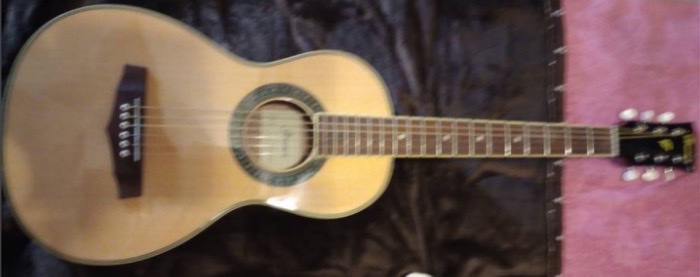
Not so with this Luna Trinity, which has a Celtic shaped sound hole, and a single cutaway that's not often seen on Parlor guitars. The basic materials are traditional; rosewood back and sides, mahogany neck, and solid spruce top, but its design makes it unmistakably not a Martin.

The size and the cutaway should affect the sound and it does, it's louder than vintage parlors in some respects, but the acoustic qualities are made somewhat irrelevant by the Orion electronics. The amplification and 4 band preamp make having a resonant acoustic sound less necessary. In fact, to shape the sound, you tend to want a clean sound that can be adjusted to the tone you want.

The acoustic sound is important because not everyone wants to plug into an amp all the time. The tone is quite good, but quieter, which may be attractive to those practicing in small apartments or in the presence of unsympathetic family or friends. The Celtic style sound hole doesn't affect the sound. As long as the sound can come out, sound hole shape isn't that important.

Like any Parlor guitar, it's extremely comfortable and easy to play with small or normal hands, and most of this type perform very well as lap slide guitars. Which lots of modern blues players are doing with vintage parlor guitars.

The price tag of around 400.00 (street price) doesn't make it an automatic purchase. At this price range, you can get a Martin, Taylor, Yamaha, or whatever that would be as good or better. Given that the sound is pretty good, and amplified anyway, it's as good a choice as any if aesthetics is a consideration.

Old school guitar thought tends to be stodgy and often like the grumblings of an old dude who prefers the old ways, which in this case is plain guitars that show the fine grain of the wood and so on. In the case of someone who finds that sensibility boring, this guitar could possibly be a revelation. Certainly, musicians who play live might find this an attractive alternative for stage work (since more than a few club players don't like to risk their vintage or expensive stuff on stage).

The one thing that might come up, of course, is that this could be seen as a “chick” guitar. That's something the market will decide and if it ends up mainly appealing to women, then Luna will have to go with that niche or promote some of their other guitars which are just as distinctive.

I personally wouldn't buy one, for the simple reason that I rarely play a six-string acoustic cutaway type, and don't need a set of stage guitars. If I had to decide between using my beloved vintage Ovation Glen Campbell and this one in front of a club audience (and risking its theft or damage) then this one would win hands down.

So, who should buy this guitar?

It's a good acoustic/electric type, and through an amp and PA system, will sound pretty much as good as any, even ones more expensive. It will give the performer a little extra on stage as the Luna Trinity's looks are distinctive and beautiful. If you play Celtic music, it seems that this guitar would be a great addition.

One thing that influences enjoyment is aesthetics. No matter what an expert might say, if you like the guitar's looks, it will sound and play better. Since the Trinity is well made and sounds more than good enough, it's worth trying out when considering others in this price range (which as I've said before, has plenty of choices).

I can't say it's an automatic buy, but one thing for sure; when looking along a wall of acoustics that all look like Martins, this one will jump out at you and maybe get you to play it first. I'm sure the design gurus at Luna can more than live with that. 

- Al Handa 

  2013

Note: This review first appeared on the ePinions.com site in 2013. This and other reviews were short takes that accompanied the link to a business that sold the guitar. As a rule, the guitar had to be at least examined and played by the reviewer (and ideally owned). In my case, a severe case of GAS made it possible to have at least owned the reviewed instrument for a short while. I'm reprinting these as having another source on a guitar never hurts, even if the reviews aren't definitive. Other than minor corrections, these short takes are unchanged from the original text. I figure that it might be helpful to keep the older perspective.


The Quitturz by Al Handa


AVAILABLE ON KINDLE UNLIMTED


AVAILABLE ON KINDLE UNLIMTED



Here's info on some of my Vella books:


The Quitturz (title not changed on ad yet)


https://www.amazon.com/kindle-vella/story/B09PC3L6PC


I, Ivy


 https://www.amazon.com/kindle-vella/story/B0B3RCBT4D


The Forbidden Lost Gospels Of Murgatroyde


 https://www.amazon.com/kindle-vella/story/B0BJ2TW4P1


The Boogie Underground Think Tank: How To Survive The End Of Civilization


 https://www.amazon.com/kindle-vella/story/B0BG6LNXTG


The Adventures Of Queen Khleopahtra: Ruler Of Egypt, Time Traveler, and Literary Detective


 https://www.amazon.com/kindle-vella/story/B0BJC122G7


Please check out and listen to my music on Spotify, YouTube, Apple Music and other music sites. Please add any cuts you like to your playlists!

Monday, April 1, 2024

Review: 2013 Seagull Entourage Rustic Grand Acoustic Six String Guitar

Review: 2013 Seagull Entourage Rustic Grand

Seagull is a Canadian company that's been building high quality, lower cost acoustics for a long time. The trend towards smaller and parlor sized guitars also has moved the industry towards their strength. The company has been building guitars that didn't always fit the Martin Dreadnaught mode since it's earliest days. Its smaller bodied 12 strings in particular have been considered excellent values.

The Seagull Entourage Rustic Grand is one of the best modern parlor sized guitars I've seen and shows that the acoustic guitar industry in general has pretty much caught up with the trend the Baby Taylors and Travel size Martin started. This parlor is in the same price range or less than the two, and arguably offers more than better value (unless the name is important, of course).

It's a guitar built to a known spec, the Parlor body, and has all the features and looks of an uncompromised design. It's sound is more modern than the traditional parlor type, that is to say, fuller, more resonant and louder. Old time parlors tend towards low volume, and a rounder, sweeter tone that most modern players will find out of sync with what they hear in this era's acoustic recordings.

The one thing that will possibly make it a cult guitar is the choice of woods. It uses wild cherry for the body and has a cedar top like a classical guitar. Wild cherry is a less commonly used wood for acoustic guitars, but it's a good one. Cherry is a very hard wood, and with the cost of rosewood going up (and becoming harder to get) you'll probably be seeing more of this wood being used for sides and bottoms in the future.

The main thing about cedar is that it doesn't “age” like a spruce top, and what you hear at purchase is what you'll basically hear years from now. Which isn’t a bad thing; no one should ever buy a guitar that doesn’t sound great off the rack. 

Those who advocate spruce tops like the idea that the wood will “open up” and improve in resonance as the years go by and feel that the sound improves as the guitar is played more. This is basically true, though a lot of the people who say that in guitar comment forums may simply be repeating what they’ve read.

The problem with that concept is that there are different grades of spruce, and a lot of the spruce used in lower cost guitars probably won't improve all that much, if at all. In fact, it's not always a given that the spruce will improve in a more expensive guitar. If you buy a spruce guitar that doesn't sound good in the hope that it will improve later on, that's an expensive gamble. 

Personally, I like cedar tops. It has a clear, bell like tone to me, and when considering an acoustic guitar, don't like the idea of buying one that sounds a bit dull or tight with the idea that it will sound better with time. If the guitar doesn't sound good now, I tend to pass. One can always buy a used high grade acoustic where it's obvious that the top has opened up and improved.

The Seagull Entourage should find an immediate audience with the smaller, but very dedicated fans of that brand. I found it easy to play, and a great balance between a louder and more resonant modern guitar and the older parlor sound. The tone isn't as defined as a Martin, it's a softer sound more related to a Koa wood guitar, but for folk and blues, this model should find a lot of buyers from those who try it.

Those considering a Baby Taylor or travel sized Martin should hold off and try out the large range of small bodied and parlor sized guitars that are hitting the market these days. Many brands are a lot cheaper the company will build that type differently, resulting in a large selection of tones and sound. In particular, those other guitars won’t have the obvious look of a guitar that's had cosmetics and other features left off for cost savings.

As I've said in other reviews, this is a good era for guitars. When the traditional leaders like Gibson and Martin became too expensive, the push to create cheaper guitars began in earnest, and as a whole, has produced inexpensive guitars that I never saw as a young man in the 70s.

Seeing all the older, smaller acoustic guitar sizes coming back into vogue has been one of the best things that could have happened to the guitar market, which was becoming a bit boring to me with its endless stream of Martin influenced dreadnoughts.

In the case of the Seagull Entourage Rustic Grand, old time is good time.

- Al Handa

  2013 

Note: This review first appeared on the ePinions.com site in 2013. This and other reviews were short takes that accompanied the link to a business that sold the guitar. As a rule, the guitar had to be at least examined and played by the reviewer (and ideally owned). In my case, a severe case of GAS made it possible to have at least owned the reviewed instrument for a short while. I'm reprinting these as having another source on a guitar never hurts, even if the reviews aren't definitive. Other than minor corrections, these short takes are unchanged from the original text. I figure that it might be helpful to keep the older perspective.


The Quitturz by Al Handa


AVAILABLE ON KINDLE UNLIMTED


AVAILABLE ON KINDLE UNLIMTED


Here's info on some of my Vella books:


The Quitturz (title not changed on ad yet)


https://www.amazon.com/kindle-vella/story/B09PC3L6PC


I, Ivy


 https://www.amazon.com/kindle-vella/story/B0B3RCBT4D


The Forbidden Lost Gospels Of Murgatroyde


 https://www.amazon.com/kindle-vella/story/B0BJ2TW4P1


The Boogie Underground Think Tank: How To Survive The End Of Civilization


 https://www.amazon.com/kindle-vella/story/B0BG6LNXTG


The Adventures Of Queen Khleopahtra: Ruler Of Egypt, Time Traveler, and Literary Detective


 https://www.amazon.com/kindle-vella/story/B0BJC122G7


Please check out and listen to my music on Spotify, YouTube, Apple Music and other music sites. Please add any cuts you like to your playlists!