The Delta Snake Review

The Delta Snake Review

Translate

Showing posts with label acoustic. Show all posts

Thursday, July 23, 2026

Review And Essay: 2025 Yamaha FS800 And The 70s Japanese Acoustics.


Review And Essay: 2025 Yamaha FS800 And The 70s Japanese Acoustics.


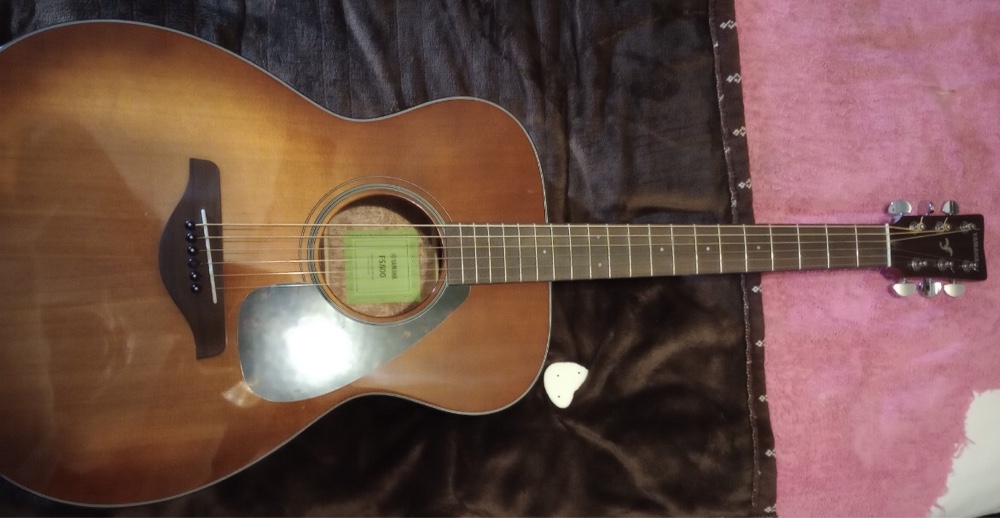
Yamaha FS800 comes with a long standing reputation as an excellent beginner and intermediate guitar. This concert size guitar has an attractive “sandburst” finish and perhaps not surprisingly, arrived in excellent condition and completely set up. Which is something about Yamaha guitars; you can generally count on them to be well built and expect for the guitar to arrive in good shape. 


When picking an online store to buy a guitar, how they store the guitar and ship it can make a big difference in the condition that arrives in. That may seem like an obvious statement, but one time I received a guitar that was just shipped in a gig bag covered with thick paper with no extra padding. I’m surprised the guitar survived.


I’ve noted in another blog entry that I once traded a Gibson Country And Western for a Yamaha plus cash, which if you knew how Yamahas sounded back then, it wasn't perceived as much of a comedown in terms of having a nice sounding guitar. 


There were some obvious differences in sound quality but in the 70s; Yamaha, Takamine and Washburn were considered excellent entry-level to intermediate guitars during a time when such guitars had previously been hard to come by. Back then, one often had to make do with an old Harmony or Silvertone, etc. so these companies brought to the market the then novel idea that there were inexpensive high quality guitars that could be bought new. 


Sure, There were good Harmonies and Silvertones, but the Japanese companies like Yamaha and Takamine contradicted the old idea that Japanese products were junk and instead produced guitars that people began to compare with Martins, or more specifically, good enough to have a lot of what premium guitars offered but at a fraction of the cost. People are used to that now with a multitude of companies, but back in the early and mid 70s, you sort of had to be there to see what a change in the guitar landscape the Japanese guitar companies brought.


For example, this FS 800 would be the kind of guitar that older players would wish were around back when they were first learning guitar. The idea that there were acoustic guitars with low action, nice construction like scalloped bracing with decent looks (ie. Looked like a Martin) would have made the old advice to buy a nylon string guitar first a thing of the past, since that advice was really about toughening the fingers up for playing acoustic guitars with high action.


This Yamaha model has been around long enough that you can check out YouTube videos to hear it played at all levels of skill, which is something I’ve always advocated. Seeing a beginner play the guitar on YouTube will often give you a clue as to how you might sound when you first start playing (and reduce any embarrassment over early mistakes, etc).


In terms of this review, I would say that the FS800 when finger picked has a smooth, mellow sound, though because of the compromise necessary to make it also a good guitar for strumming (the more common usage), the bass can overpower the mids and treble. You'll have to make some allowance for that when finger picking but by the same token, it makes for a really nice rhythm guitar for accompaniment. Also, certain types of flat picking sound better when you have strong bass and mids.


The level of balance between the strings is good enough that you can make adjustments to have an equal amount of volume, something you can’t always do with a cheapo guitar. Another way to put it, it could be that the strong bass (lows) and mids can help a beginner when first learning chords, then as they get better, they can make minor adjustments in their technique to have a nice balanced sound.


My main acoustic is a Gibson and an old Regal parlor but the Yamaha is an excellent third guitar to keep in a different tuning. The FS800 is highly recommended for a beginner because this is the type of guitar that can make him or her sound good all the way up to the intermediate levels and to enjoy the process.


Believe me, back in the 70s it wasn’t a given that you could have both good sound and a pleasurable playing experience. So, to use an old phrase, yes, I do wish there were more guitars like this when I was first starting.


Al Handa

July 23, 2026


Specs:


Top Material  Spruce Wood

 Body Material  Mahogany 

Back Material  Rosewood

Neck Material  Nato Wood 

Fretboard Material  Rosewood

Body type: Concert/O

Cutaway: Non-cutaway

Top wood: Solid Spruce

Back & sides: Nato/okume 

Bracing pattern: Scalloped

Body finish: Gloss

Orientation: Right handed

Nut width: 1.69" (43 mm)

Fingerboard: Rosewood

Neck wood: Nato

Scale length: 25"

Number of frets: 20

Neck finish: Matte

Pickup/preamp: No

Headstock overlay: Rosewood

Tuning machines: Die-cast chrome

Bridge: Rosewood

Saddle & nut: Urea

Number of strings: 6-string



Sunday, July 19, 2026

Aftermarket Report: 2021 Gibson G-45


Aftermarket Report: 2021 Gibson G-45


I first reviewed this guitar in April, which was about two months after I bought it; so this aftermarket report is approximately 6 months after purchase. This guitar is now my favorite acoustic (if not overall). It’s the one I seem to pick up all the time and play even if I only have a few minutes. 


So, I can say that this purchase was a success, not only because I got it at such a good price due to its repairs, but the fact that there's a fun factor that keeps me playing it. By the same token, there's some things people should know before buying this guitar, at least from my experience. 


If you look through the past reviews on the internet, you'll see that it was basically an attempt by Gibson to create a solid wood American acoustic guitar for under a thousand, and that's what the initial price was. It didn't stay that low and eventually went up to 1200 and above but at the time it was a bargain. 


I recently saw another brand being reviewed, a very famous brand which I won't name per se, that has a classic solid wood acoustic made in Mexico for just under $1,000 that is getting rave reviews. So, in terms of the Gibson G-45 being manufactured in the United States at that same price point, one could say that it was either a great achievement or an incredibly lucky break for a lot of guitar players who ignored some of the initial lousy and frankly inaccurate reviews that I was seeing about this guitar. Years down the line, if you look at the various reviews now, you'll find it’s overwhelmingly liked by its users.


I should point out one thing; that it being a very nice guitar, that is to say, not made cheaply, it's going to be more delicate than a regular run of the mill guitar. I live in a place where the humidity can go up and down drastically as with the temperature and what I found about this guitar is it has a very lively neck. 


The guitar action originally was set a bit higher than Gibson spec. I brought it down to where I liked it but found a couple of months later, when the climate changed that it started buzzing so the strings were brought back up. 


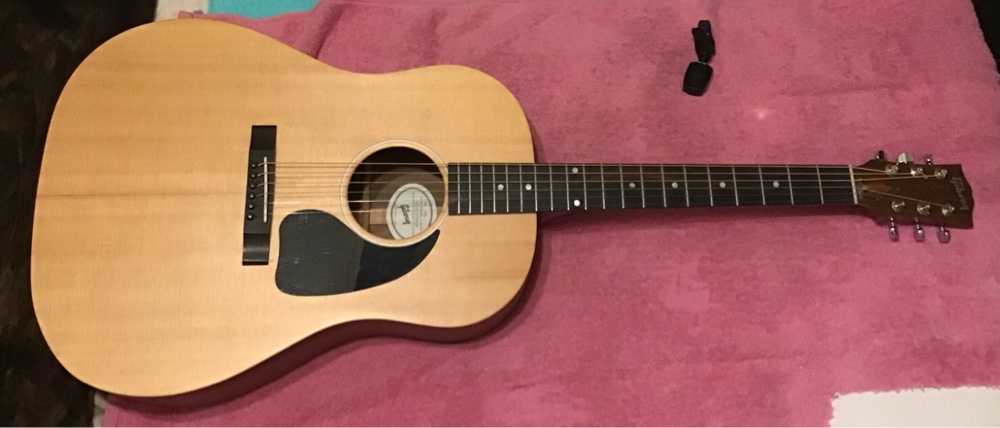
As you can see from the photo, after adjusting the neck every few weeks, I started keeping the truss rod cover off so the neck could be adjusted without eventually stripping the screws. It eventually ended up being adjusted a bit higher, around Gibson spec., like it was when it arrived. That allows for the various fluctuations in heat and humidity that occur where I live, which is Illinois. Those who live in that state, as with a lot of the Midwest, know that the humidity level and heat can be extremely high followed by sudden rains and drops in temperature. 


Now, as far as aftermarket comments in terms of the sound, I use 80/20 bronze strings, not the phosphor bronze, because I like the slightly scooped sound and on this guitar, it brings out a brilliant treble and, I guess you could say a sharper bass.


I've never quite warmed up to phosphor brass strings even though those are considered the best in terms of mid-range, etc. I've always felt it made the guitar sound a little too sweet. I also pick with my fingernails and don't bother to use a thumb pic, so the extra treble that you get from a bronze set helps. That's just a personal preference but I find that 80-20 brass works really well on this particular guitar which has a balanced tone and, I guess you could say, is a brighter sounding guitar than other Gibsons that I've owned and heard.


The port on the side hasn't gotten old, in fact for leisure playing I would say that it's a recommended feature particularly if you're not gigging or recording. It really adds to the pleasure of playing the guitar. As far as reducing the amount of bass, I don't really think it does that in the classic sense of the word, it just seems that way because its sound is a bit more ethereal or atmospheric.


In fact with some other acoustics I have, it’s now kind of odd hearing those because the sound projects out more and sounds a little distant, if that makes sense. Your results may vary of course. 


So, half a year down the line that's my impression of the Gibson G-45. I think if you can get a used one, by all means at least try it out; I think you'll find it's a great guitar and it's certainly my number one acoustic. The guitar top after five years of playing playing has opened up and the sound has a resonance that isn’t present in the YouTube videos, most of which were recorded a few years ago when the G-45 first came out. It will age well as a Gibson with a definite Taylor flavor. 


It’s always nice have a story with a happy ending instead of why a guitar was sold or traded off.


Note: One correction: I accidentally dated the guitar by it’s purchase date, not it’s actual date of manufacture, which is 2021 as part of the Generation Series.


Al Handa

July 19, 2026


Monday, April 1, 2024

Review: 2013 Seagull Entourage Rustic Grand Acoustic Six String Guitar


Review: 2013 Seagull Entourage Rustic Grand

Seagull is a Canadian company that's been building high quality, lower cost acoustics for a long time. The trend towards smaller and parlor sized guitars also has moved the industry towards their strength. The company has been building guitars that didn't always fit the Martin Dreadnaught mode since it's earliest days. Its smaller bodied 12 strings in particular have been considered excellent values.

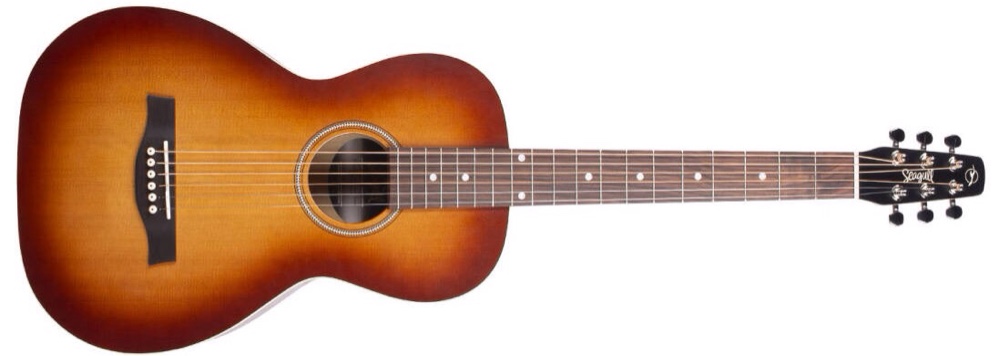
The Seagull Entourage Rustic Grand is one of the best modern parlor sized guitars I've seen and shows that the acoustic guitar industry in general has pretty much caught up with the trend the Baby Taylors and Travel size Martin started. This parlor is in the same price range or less than the two, and arguably offers more than better value (unless the name is important, of course).

It's a guitar built to a known spec, the Parlor body, and has all the features and looks of an uncompromised design. It's sound is more modern than the traditional parlor type, that is to say, fuller, more resonant and louder. Old time parlors tend towards low volume, and a rounder, sweeter tone that most modern players will find out of sync with what they hear in this era's acoustic recordings.

The one thing that will possibly make it a cult guitar is the choice of woods. It uses wild cherry for the body and has a cedar top like a classical guitar. Wild cherry is a less commonly used wood for acoustic guitars, but it's a good one. Cherry is a very hard wood, and with the cost of rosewood going up (and becoming harder to get) you'll probably be seeing more of this wood being used for sides and bottoms in the future.

The main thing about cedar is that it doesn't “age” like a spruce top, and what you hear at purchase is what you'll basically hear years from now. Which isn’t a bad thing; no one should ever buy a guitar that doesn’t sound great off the rack. 

Those who advocate spruce tops like the idea that the wood will “open up” and improve in resonance as the years go by and feel that the sound improves as the guitar is played more. This is basically true, though a lot of the people who say that in guitar comment forums may simply be repeating what they’ve read.

The problem with that concept is that there are different grades of spruce, and a lot of the spruce used in lower cost guitars probably won't improve all that much, if at all. In fact, it's not always a given that the spruce will improve in a more expensive guitar. If you buy a spruce guitar that doesn't sound good in the hope that it will improve later on, that's an expensive gamble. 

Personally, I like cedar tops. It has a clear, bell like tone to me, and when considering an acoustic guitar, don't like the idea of buying one that sounds a bit dull or tight with the idea that it will sound better with time. If the guitar doesn't sound good now, I tend to pass. One can always buy a used high grade acoustic where it's obvious that the top has opened up and improved.

The Seagull Entourage should find an immediate audience with the smaller, but very dedicated fans of that brand. I found it easy to play, and a great balance between a louder and more resonant modern guitar and the older parlor sound. The tone isn't as defined as a Martin, it's a softer sound more related to a Koa wood guitar, but for folk and blues, this model should find a lot of buyers from those who try it.

Those considering a Baby Taylor or travel sized Martin should hold off and try out the large range of small bodied and parlor sized guitars that are hitting the market these days. Many brands are a lot cheaper the company will build that type differently, resulting in a large selection of tones and sound. In particular, those other guitars won’t have the obvious look of a guitar that's had cosmetics and other features left off for cost savings.

As I've said in other reviews, this is a good era for guitars. When the traditional leaders like Gibson and Martin became too expensive, the push to create cheaper guitars began in earnest, and as a whole, has produced inexpensive guitars that I never saw as a young man in the 70s.

Seeing all the older, smaller acoustic guitar sizes coming back into vogue has been one of the best things that could have happened to the guitar market, which was becoming a bit boring to me with its endless stream of Martin influenced dreadnoughts.

In the case of the Seagull Entourage Rustic Grand, old time is good time.

- Al Handa

  2013 

Note: This review first appeared on the ePinions.com site in 2013. This and other reviews were short takes that accompanied the link to a business that sold the guitar. As a rule, the guitar had to be at least examined and played by the reviewer (and ideally owned). In my case, a severe case of GAS made it possible to have at least owned the reviewed instrument for a short while. I'm reprinting these as having another source on a guitar never hurts, even if the reviews aren't definitive. Other than minor corrections, these short takes are unchanged from the original text. I figure that it might be helpful to keep the older perspective.


The Quitturz by Al Handa


AVAILABLE ON KINDLE UNLIMTED


AVAILABLE ON KINDLE UNLIMTED


Here's info on some of my Vella books:


The Quitturz (title not changed on ad yet)


https://www.amazon.com/kindle-vella/story/B09PC3L6PC


I, Ivy


 https://www.amazon.com/kindle-vella/story/B0B3RCBT4D


The Forbidden Lost Gospels Of Murgatroyde


 https://www.amazon.com/kindle-vella/story/B0BJ2TW4P1


The Boogie Underground Think Tank: How To Survive The End Of Civilization


 https://www.amazon.com/kindle-vella/story/B0BG6LNXTG


The Adventures Of Queen Khleopahtra: Ruler Of Egypt, Time Traveler, and Literary Detective


 https://www.amazon.com/kindle-vella/story/B0BJC122G7


Please check out and listen to my music on Spotify, YouTube, Apple Music and other music sites. Please add any cuts you like to your playlists!