The Delta Snake Review

The Delta Snake Review

Translate

Showing posts with label acoustic guitar. Show all posts

Sunday, July 12, 2026

Retrospective: 1968 Gibson Country and Western and 1972 Yamaha FG-150'


Retrospective: 1968;Gibson Country and Western and 1972 Yamaha FG-150


I’m going to try out different review formats. There is the “Aftermarket” and this will be a “Retrospective” review, which is the best way to put it, as it’ll be descriptions of classic (and not so classic) instruments. As much as possible, it’ll be about the subject and not my internal stream of consciousness, which doesn’t add very much to the lore and collective knowledge on the Internet.


There are classic acoustic guitars that I didn't own for a great deal of time, like for example, a 1968 Gibson Country And Western, which I owned for about 3 months and ended up trading for a Yamaha and cash (for musician financial reasons). 


The Country And Western is now a highly sought after guitar in the vintage market (and by many players who were turned on to the guitar by celebrities like Sheryl Crow). 


Many of us older players have recollections of vintage guitars that were casually traded or sold because we simply didn't know their future value. Also, there's a lot of vintage instruments that these days have a highly elevated reputation mainly because of their high value as collector items. In the case of the Gibson country western, it was traded for financial reasons and playability issues.


The '70s were a time when tapping a tuning fork and holding it in your teeth to get a concert A note to tune your guitar by was considered sophisticated, so that gives you an idea of what the era could be like back then.


The 1968 Gibson Country Western Acoustic 6 string was the square shoulder model, which in my case had the natural finish. It had a solid spruce top and mahogany back and sides and it still is one of the best sounding guitars I've ever had. 


It was in 1974; I was trading in an 60s Gibson ES-330 which wasn't quite what I needed in terms of electric finger picking and thought an acoustic guitar would be better for solo (unaccompanied) work. That may seem odd to a modern player for someone to start playing finger style with an electric, but my inspirations at that time were Jorma Kaukonen of Hot Tuna and John Cipolina of Quicksilver, both of whom did a lot of finger picking.


The Gibson country western had a sound that, if you want to compare it to a modern guitar, struck me as being kind of similar to the Hummingbird in tone (of course nowadays you can listen to it on YouTube in various configurations and years). 


I found it unsuitable for finger picking, and was warned at the time by the guitar store owner that a finger picker could find the string spacing a little too narrow. That turned out to be the case, the spacing was ideal for playing with a pick, that is to say rhythm guitar and flat picking. I had small hands so I could manage finger style on the Gibson but  it was easy to make mistakes in that tight space.


Also, I used open tunings and it could be difficult to finger a lot of notes and chords. It was more suitable for standard chords as you could simply bar off the position with a single finger; but beyond that you had to be careful because it was easy to accidentally mute a string or two with your fingers. 


I eventually traded it for a less expensive guitar and cash, which is what I needed to do at the time for various reasons. That led me to a lower cost model that I liked quite a bit.


1972 Yamaha FG-150 (Bought used, so model year could be wrong)


The various Yamaha acoustic guitars in the 70s were quite popular and developed a reputation as excellent low cost guitars. Even their high-end offerings were less expensive than the name brand Gibsons and Martins, etc. Those lower cost models filled the gap caused by the increasing price of Takamines, which were considered at the time among many guitar players, the only import that was reasonably comparable to American brands.


That might seem odd to a modern player in 2026 because now there are dozens of guitars in each of the various price ranges but back in the 70s, your choices were considerably more limited. Yamaha and Takamine didn’t have a lot of competition in many areas, as most economy models by the American companies were still relatively high priced.


Like many inexpensive guitars these days, both electric and acoustic, these two were possibly over praised back in the '70s which tended to create the same disagreement that sometimes you hear in guitar forums today. 


The success of the Takamine guitars (and the increasing price of both the new and used models) left a gap in the lower end that Yamaha and later Seagull filled. I could never find a good used Seagull because those tended to have bowed necks. That was one thing about Seagulls back in the seventies; it wasn't easy to find a used one with a straight neck at a good price. That's an anecdotal judgment, of course, but that was my experience at the time in the various used guitar stores, etc., when I tried to find one (one store was selling new ones with noticeable bowed necks). I’m aware that a lot of guitarists loved the Seagull.


The Yamaha FG-150, in terms of playability for a guitarist with small hands, was an improvement over the Gibson Country And Western. The string spacing was wider which made it easier to finger pick. Incidentally, the common phrase in my area of California for that type of guitar was “folk” style or spacing). The actual size was comparable to the Martin triple-0 so it was also a very comfortable instrument.


There are excellent Yamaha sites on the Web that detail the history of those various lines and models, which is a sign that the guitars were and still are highly regarded. The one thing that did keep the Yamaha from being considered equal to American guitars was, of course, the Yamaha’s laminate wood construction compared to the solid woods in the higher end American brands.


The laminate construction of the Yamaha did have one advantage; what you heard is what you got. In other words if the guitar sounded good at the time it was going to keep sounding good. It may not have “improved” like a solid wood top but by the same token you could buy a solid top back then and it wouldn't necessarily age and eventually sound the way you would want it to. One still tended to buy those for the same reason you would buy a laminate, for the sound that you heard at the time.


I think that’s one reason why used acoustics were so popular back then in the 70s; with higher end guitars like Gibson, the tops had either improved with age or stayed tight and a buyer could hear what it would sound like after being broken in. When you think about it, telling people that a solid top guitar will sound a lot better later on, that may have been the way things were, can make the evaluation of a new high-end guitar a lot tougher. The same with taking it to resale value into account.


Those are two acoustics that I once owned. One of the reasons I didn’t list technical specs is because those are easily available on the internet. These days it’s necessary to have the specs available as there’s so much choice at every price tier but believe it or not, in the old days, we were often grateful to just have a playable guitar at the price range we could afford.


Reminds me of the time I was in a small guitar store and they were selling a line of acoustics that apparently were favored by such famed guitarist as John Fahey. The salesman spent over half an hour explaining why the guitar was so good. A lot of the details that seem common now sounded very exotic back then. Also, such pitches were necessary because back then a good guitar could be easily priced out of reach and often customers had to be talked into buying one. 


There was a similar story in another guitar store I visited to check out strats and admittedly, that’s all I was going to do because I couldn’t afford one. The owner realized that and spent over 45 minutes trying to sell me a Mustang. The fact that he could devote that kind of time to me gives you an idea of how the guitar market could be like back then. I was actually the only customer in that store for over an hour.


The next one I'm going to write about was one of my favorite inexpensive 12 strings. I had actually quit playing guitar for a few years in the 80s but eventually picked up an older Yamaha 12 string which I hung on to for over 15 years. It’s a tribute to the quality that company was famous for, that unlike a lot of 12 strings in the era, the one that I bought used never developed a neck problem, which was common back in the seventies and eighties for various reasons which I'll discuss in the future review. I also talked about that a bit in one of my reviews about 12 strings on this site.


I was able to sell it for what I paid for it and condition was such that the buyer bought it without any questions.


So, coming up next, the immortal cheap Yamaha 12 string…


Al Handa

July 12, 2026



Tuesday, April 22, 2025

Review and Essay: 2024 Gibson G45 Six String Acoustic / The Art of Interpreting Online Reviews


Review and Commentary: The Gibson G-45 six-string acoustic and the Art of interpreting online guitar reviews 

One of the first things a savvy guitar buyer does when considering any model is to research it on the Internet. In some cases, the person may have a friend who already owns the model, and he can get a first-hand look at it or check it out at a nearby Guitar store. 

A good way to develop a preliminary judgment on a guitar is to see how many good comments it gets in user review sections. However, that can be confusing because there'll sometimes be experts or vocal guitarists in comment sections who claim those are superficial impressions from people who love the guitar they just bought.

In other words, the implication is many of these happy new customers don't know better. That can be a valid point when discussing technical specifications or judging the build quality of a particular guitar. However, it sometimes creates the dichotomy of users liking a specific model while many experts consider it mediocre or a poor buy/investment. 

The investment angle is an essential factor to consider not only for the possible future sale of the guitar but also for the type of bias it can introduce into a review. Whether or not a guitar will increase or even hold its value is a factor that can mean everything or nothing in terms of the actual pleasure and utility of a guitar. 

…contradiction…

This contradiction between consumers and experts was clear to me when I was considering the purchase of a Gibson G-45, an economy model that costs around a thousand dollars new and has received quite a few mixed or negative reviews (with many seconding opinions in the comment sections).

The reviews and commentary were particularly negative on YouTube, with some experts openly contemptuous. The main objection seemed to be the price; many commentators didn't think it was worth $1,000 and didn't really "sound like a Gibson." 

I have to admit that when I looked at the various YouTube reviews, the sound of the G45 struck me as similar to a Taylor or Guilds that I've heard, but it did have a bit of the Gibson flavor.

I wasn't looking for a traditional Gibson sound anyway. I have a vintage parlor with the old Gibson LG0 sound, so I was looking for something more "modern” in sound. There was a G45 that only cost $600, so I was only checking the reviews to see if it was a good deal.

…video reviews…

Checking out video reviews isn’t an ideal way to evaluate a guitar; it's always better to play it, but it's a good way to get a feel for a possible online purchase. It's also a good idea to check both bad and good opinions. Sometimes, a negative comment can highlight a serious flaw in an instrument.

However, checking out bad reviews is more about being thorough and open-minded because those often reflect that particular reviewer's taste or criteria, which doesn't necessarily match mine.

I remember watching a review of this particular Gibson. From the start, the reviewer showed his distaste for the guitar and played it in a public and noisy environment, which I would never do with an acoustic instrument. There's a reason why most guitar stores have a quiet room where acoustic instruments can be tested. Ambient noise can make it difficult to judge the acoustic tone, which is a complex blend of sound from different guitar parts and your technique.

The person didn't like the guitar, and that's okay, but it was clear that the guitar wasn't fairly tested. The negative opinions in agreement in the comment section were mainly from people who hadn't even personally seen or played the guitar.

I quit watching the person's reviews after that (there were other borderline reviews of his). There's a difference between being opinionated (which is okay) and being peevish or dismissive. 

Most online reviews are a single person's experience with a particular guitar. While it can't possibly be a definitive analysis of the entire line, it can be a valuable opinion from someone who has had an experience with the instrument. A reasonably careful evaluation is helpful even if you disagree with the conclusion.

If the person is opinionated, like I said, that's okay because someone with a passion for guitars will take the time to look at it (in most cases), and one can always take any bias into account when judging the content of the review. However, when a reviewer simply blows off an instrument, I consider it a waste of time to watch (or read) such a review. 

…good reviews…

It's just as important to be careful about the good reviews, too, because if those are featured on a commercial website, certain biases are always going to be there. For example, no matter how good an economy brand might be, most reviewers who work for a site will always add that it's a “beginner guitar” or similar classification that makes sure that you know it's not as good as a more expensive model.

That informal caste system is there because these sites depend on advertising from manufacturers. The reviews will be carefully worded to ensure that the advertiser's entry-level line is seen as a logical step toward the future purchase of professional-level instruments. A reviewer might note that a particular high-end model is expensive, but he or she will rarely tell people to go buy a cheaper model instead.

Another reason such reviews may not be useful is that reviewers often use language that doesn't tell you what the instrument is like. When one thinks about it, what does it really mean when someone says a guitar has "a vintage sound," "best for classic rock," or "is too quiet? " There are a lot of standard review phrases that really don't mean anything except maybe in a subjective sense.

Also, to assume that anyone or even a group of reviewers can tell you a lot about a particular product line isn't a given. In any scientific study, the researchers always want a sample size that is as large as possible. No one would ever approve a new medication based on a test on a dozen people; for such products, it can take years and tests on thousands of case subjects before anyone can conclude a new product. 

In terms of the entire product line of a guitar, it's already understood that some guitars within that line will be better than others due to construction and other factors, so it's not necessarily a good idea to base any purchase on any review or any group of reviews unless you actually can try out the instrument yourself. Or, at the least, buy it from an online site or brick-and-mortar store that has a good return policy.

That's why the recent spate of negative reviews on the new Fender Standard line, which most people haven’t seen yet, shouldn’t be taken seriously. Until a large enough group of people have real-world experience with the guitar, at least in a store or through online purchases, there's no way to know how good those guitars are.

…back to the G45…

But, getting back to the Gibson G45, I noticed that purchaser reviews were generally good. A lot of people who actually bought the guitar liked it, so the large number of reviewers who didn't like the guitar wasn't that relevant to me. 

If that group of users were mainly people who tried it out in the store and said they liked it, then that would have to be taken into account, but if people who buy it like it and want to keep the guitar, that does mean something.

One reason I looked into buying this particular model was that it was a stripped-down Walnut body version of the very popular J45 model (which uses mahogany). I should note that both have spruce tops. However, I wasn't interested in it at the new price of 1,000. In fact, I wasn't that interested in any new guitar, for that matter.

If that's what I wanted, I would have the money to buy an actual J45, but I wasn't looking for that "classic Gibson sound." I was looking for a more modern tone that would fit the instruments I've been recording with. Until I ran across the possible deal on the G45, I was looking at various used Taylors and Guilds.

Now, running across a used G45 at 600.00 was a different story. It was only a year old, and it was cheaper because the top had a repaired crack. That's a deal breaker for quite a few people, though in my case, after over 50 years of playing guitar, I don't personally treat any crack in the body of an acoustic guitar as that big a deal as long as it's been properly repaired and the price reflects it.

To make a long story short, I liked it better than the various other guitars I was looking at, so I purchased it.

…a closer look…

I held off writing a review of the instrument for a couple of months until I played it for a while. So far, it's been an excellent value, and I like the sound. I should add that the J45-size body makes it extremely comfortable to play.

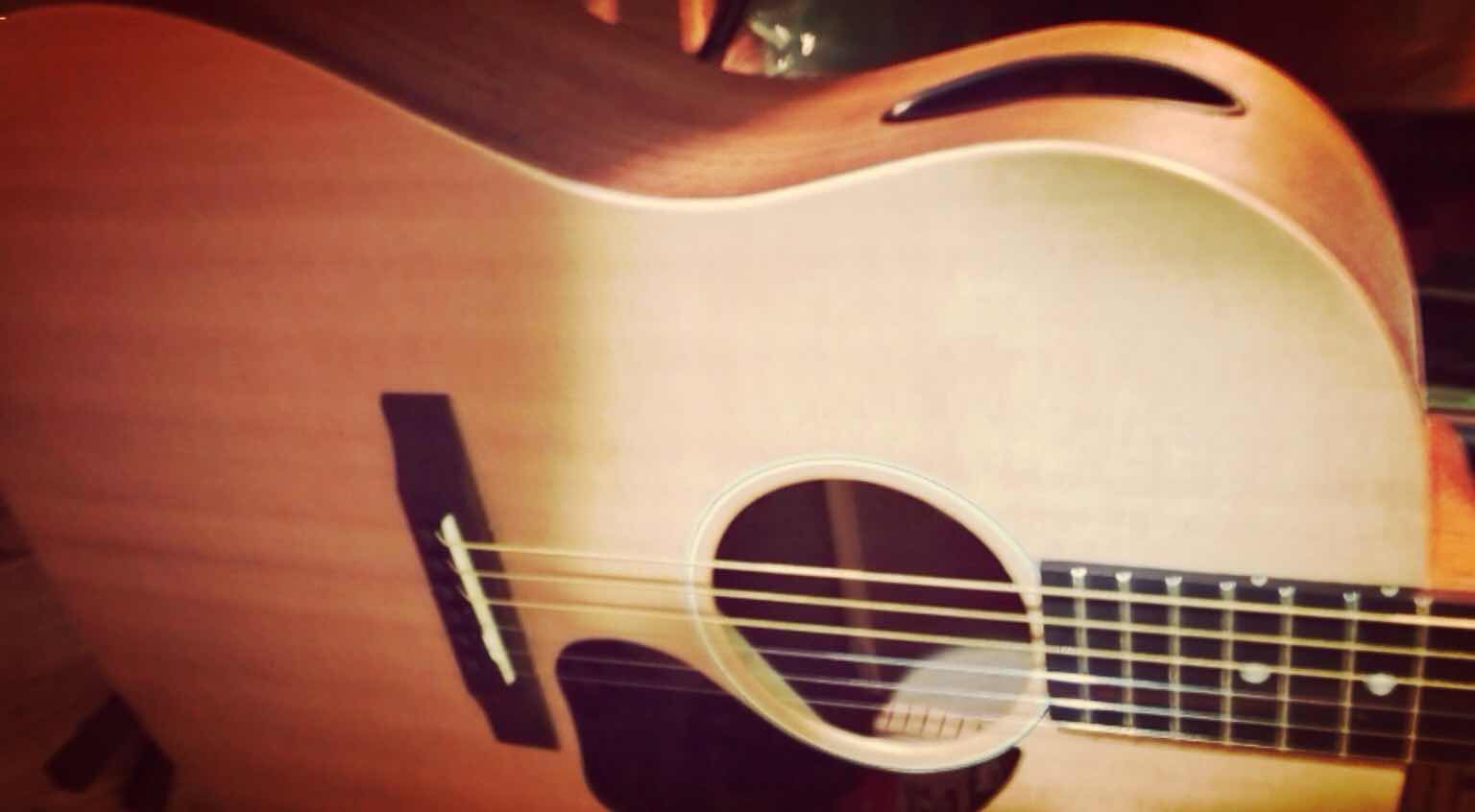
One feature that was liked by many users but received mixed reviews online and in comment sections was the "Player Port" on the side of the guitar, which is intended to project more sound upwards towards the player.

The sound hole makes a lot of sense when one plays it in a room instead of watching it on a video. Most of your playing will be alone in a room, and having more mids and highs project upwards adds to the experience. One can always plug the hole up for recording if that makes a difference

I saw some comments that claim it reduces the amount of bass, but it really doesn't do that; it projects a more balanced sound that’s more like what's coming out of the front of the guitar. If a player has spent most of their time playing the guitar without a Player Port, they will hear what could be described as a deeper sound because you're not directly in front of the guitar. That can certainly give the impression that there's less Bass. 

The neck has what Gibson calls an "advanced response neck profile," which in technical terms means a soft V-neck that becomes a modern C profile by the 9th fret. It does have a slightly thicker feel in the first and second positions than some modern acoustics, but it feels easier to play as you move up the neck.

In terms of sound, it has a Gibson-like tone. The G45 has a sweet tone all the way up the neck but gets a bit quieter up there compared to a Martin or Taylor. That tonality isn’t apparent in videos because of the relatively poor sound quality in the recording and from the device, which is generally a phone or tablet.

…an honest guitar…

The G45 reminds me of a Fender Telecaster, an "honest" guitar. If you play it indifferently, it'll sound mediocre, and you'll hear every mistake. However, like a Tele, if you play it, it does certain things you usually wouldn't see from an old Gibson. 

In other words, you can get a lot of different tones, particularly when playing fingerstyle. You can make it sound like a Taylor or the kind of sharper tone you hear on many recordings these days, or you can get more of the old Gibson sound, which is very sweet and rich. The notes can be sharp or round or a little of both; it's a guitar that responds to touch and phrasing. That makes it an excellent guitar for recording.

This Gibson has a nice punchy sound when played with a pick, and players of all skill levels will find them excellent guitars for almost any genre of music. However, you might prefer a more traditional Gibson or Martin tone.

The best thing I can say about the G45 is you can make the tone as complex as you want, or you can back off, relax, and enjoy it as a leisure guitar. There are many beginner or intermediate guitars you can't say that about. Some sound quite pleasant, but they won't respond to intricate playing or give you a different sound.

One reason the tone is more versatile is that it has excellent balance across the strings. Many cheaper guitars tend to be bassier or booming because that appeals to many people who play chords or strum a lot, and that's frankly not a “bad” characteristic. It’s really just being optimized for a price range and potential.

For example, my Yamaha sounds great for relaxed playing, but the bass tends to overwhelm the mids and treble. The excellent balance of the G45 makes it a superb fingerstyle guitar, and if you flat-pick, all of your notes will come out as nice and clear as you want.

…mojo rising…

I do have to add that part of the enjoyment is mojo. In other words, I got it reasonably priced, so I can't necessarily say how I would feel about it if I paid $1,000. When you get up into that price range, even if it's considered an "economy" price for a Gibson (or other brands like Martin, Taylor, etc.), there are many excellent choices, and there were some Guilds in particular that I liked. That said, after playing the Gibson for a couple of months, I wouldn't sell it to get one of those Guilds. Also, given what I know about the guitar from experience, I would consider buying it new.

Honestly, even after a couple of months, I haven't noticed the exact specs and build quality other than looking up the data after purchase. I don't personally look at specs very closely when considering the purchase of a guitar except where they might affect the price. Those of you who've read many of my reviews will know that I assume that exact technical specs can be considered part of a thorough research on any guitar anyway.

I should note that my attention to technical detail is idiosyncratic.

…attention…

I pay attention to certain things, like whether the guitar has X or ladder bracing, etc. However, unlike some reviewers, I don't consider one or the other necessarily superior in terms of sound. Both have characteristics that make them ideal for different genres and guitar styles. X bracing is considered exceptional in terms of support, but if you're looking to get the old Blues sound, for example, you do have to consider getting a ladder-braced guitar (because that was the type with which most of the old classics were recorded).

I also can't help thinking that the mixed reviews from reviewers also helped drive the used price down, so perhaps the negative reviews ended up helping me.

In any case, my experience with the guitar just reinforces my feeling that online reviews are a helpful tool but hardly something on which I would base a decision. Your own instincts and how you feel about a guitar when you play it are always going to be more important.

It's always a good idea to review the reviewers when researching guitars online…

- Al Handa
  4/19/2025

G45 Specs:

Natural Finish
Sitka Spruce Top
Walnut Back and Sides
Scalloped X Bracing
Utile Neck Material
Richlite Fingerboard
Advanced Response Neck Profile
24.75" Scale Length
20 x Standard Fret
Tusq Nut Material
1.73" Nut Width
Richlite Bridge
Traditional Belly Up Bridge
Tusq Saddle Material
Tusq Bridge Pins
Mini Grover Rotomatic Tuners
G Series Padded Gig Bag