The Delta Snake Review

The Delta Snake Review

Translate

Showing posts with label yamaha. Show all posts

Thursday, July 23, 2026

Review And Essay: 2025 Yamaha FS800 And The 70s Japanese Acoustics.


Review And Essay: 2025 Yamaha FS800 And The 70s Japanese Acoustics.


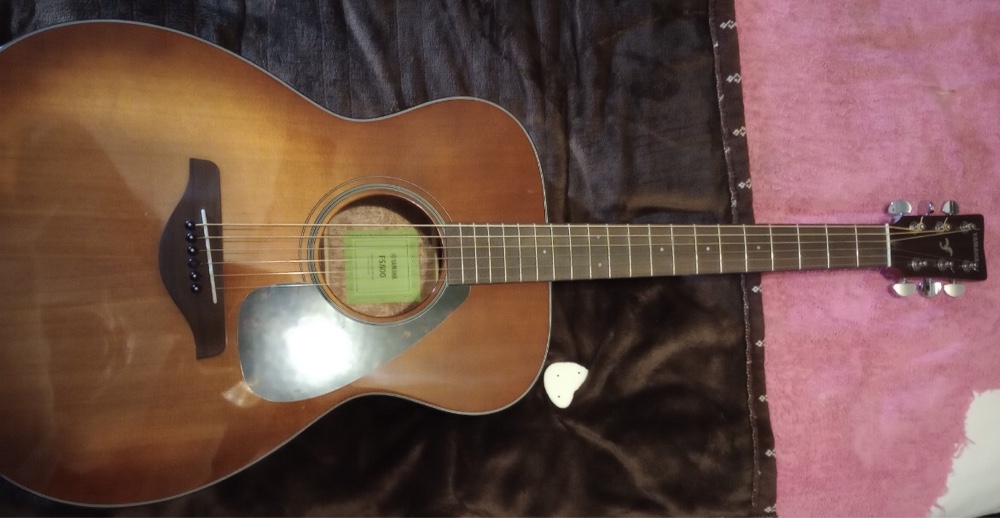
Yamaha FS800 comes with a long standing reputation as an excellent beginner and intermediate guitar. This concert size guitar has an attractive “sandburst” finish and perhaps not surprisingly, arrived in excellent condition and completely set up. Which is something about Yamaha guitars; you can generally count on them to be well built and expect for the guitar to arrive in good shape. 


When picking an online store to buy a guitar, how they store the guitar and ship it can make a big difference in the condition that arrives in. That may seem like an obvious statement, but one time I received a guitar that was just shipped in a gig bag covered with thick paper with no extra padding. I’m surprised the guitar survived.


I’ve noted in another blog entry that I once traded a Gibson Country And Western for a Yamaha plus cash, which if you knew how Yamahas sounded back then, it wasn't perceived as much of a comedown in terms of having a nice sounding guitar. 


There were some obvious differences in sound quality but in the 70s; Yamaha, Takamine and Washburn were considered excellent entry-level to intermediate guitars during a time when such guitars had previously been hard to come by. Back then, one often had to make do with an old Harmony or Silvertone, etc. so these companies brought to the market the then novel idea that there were inexpensive high quality guitars that could be bought new. 


Sure, There were good Harmonies and Silvertones, but the Japanese companies like Yamaha and Takamine contradicted the old idea that Japanese products were junk and instead produced guitars that people began to compare with Martins, or more specifically, good enough to have a lot of what premium guitars offered but at a fraction of the cost. People are used to that now with a multitude of companies, but back in the early and mid 70s, you sort of had to be there to see what a change in the guitar landscape the Japanese guitar companies brought.


For example, this FS 800 would be the kind of guitar that older players would wish were around back when they were first learning guitar. The idea that there were acoustic guitars with low action, nice construction like scalloped bracing with decent looks (ie. Looked like a Martin) would have made the old advice to buy a nylon string guitar first a thing of the past, since that advice was really about toughening the fingers up for playing acoustic guitars with high action.


This Yamaha model has been around long enough that you can check out YouTube videos to hear it played at all levels of skill, which is something I’ve always advocated. Seeing a beginner play the guitar on YouTube will often give you a clue as to how you might sound when you first start playing (and reduce any embarrassment over early mistakes, etc).


In terms of this review, I would say that the FS800 when finger picked has a smooth, mellow sound, though because of the compromise necessary to make it also a good guitar for strumming (the more common usage), the bass can overpower the mids and treble. You'll have to make some allowance for that when finger picking but by the same token, it makes for a really nice rhythm guitar for accompaniment. Also, certain types of flat picking sound better when you have strong bass and mids.


The level of balance between the strings is good enough that you can make adjustments to have an equal amount of volume, something you can’t always do with a cheapo guitar. Another way to put it, it could be that the strong bass (lows) and mids can help a beginner when first learning chords, then as they get better, they can make minor adjustments in their technique to have a nice balanced sound.


My main acoustic is a Gibson and an old Regal parlor but the Yamaha is an excellent third guitar to keep in a different tuning. The FS800 is highly recommended for a beginner because this is the type of guitar that can make him or her sound good all the way up to the intermediate levels and to enjoy the process.


Believe me, back in the 70s it wasn’t a given that you could have both good sound and a pleasurable playing experience. So, to use an old phrase, yes, I do wish there were more guitars like this when I was first starting.


Al Handa

July 23, 2026


Specs:


Top Material  Spruce Wood

 Body Material  Mahogany 

Back Material  Rosewood

Neck Material  Nato Wood 

Fretboard Material  Rosewood

Body type: Concert/O

Cutaway: Non-cutaway

Top wood: Solid Spruce

Back & sides: Nato/okume 

Bracing pattern: Scalloped

Body finish: Gloss

Orientation: Right handed

Nut width: 1.69" (43 mm)

Fingerboard: Rosewood

Neck wood: Nato

Scale length: 25"

Number of frets: 20

Neck finish: Matte

Pickup/preamp: No

Headstock overlay: Rosewood

Tuning machines: Die-cast chrome

Bridge: Rosewood

Saddle & nut: Urea

Number of strings: 6-string



Sunday, July 12, 2026

Retrospective: 1968 Gibson Country and Western and 1972 Yamaha FG-150'


Retrospective: 1968;Gibson Country and Western and 1972 Yamaha FG-150


I’m going to try out different review formats. There is the “Aftermarket” and this will be a “Retrospective” review, which is the best way to put it, as it’ll be descriptions of classic (and not so classic) instruments. As much as possible, it’ll be about the subject and not my internal stream of consciousness, which doesn’t add very much to the lore and collective knowledge on the Internet.


There are classic acoustic guitars that I didn't own for a great deal of time, like for example, a 1968 Gibson Country And Western, which I owned for about 3 months and ended up trading for a Yamaha and cash (for musician financial reasons). 


The Country And Western is now a highly sought after guitar in the vintage market (and by many players who were turned on to the guitar by celebrities like Sheryl Crow). 


Many of us older players have recollections of vintage guitars that were casually traded or sold because we simply didn't know their future value. Also, there's a lot of vintage instruments that these days have a highly elevated reputation mainly because of their high value as collector items. In the case of the Gibson country western, it was traded for financial reasons and playability issues.


The '70s were a time when tapping a tuning fork and holding it in your teeth to get a concert A note to tune your guitar by was considered sophisticated, so that gives you an idea of what the era could be like back then.


The 1968 Gibson Country Western Acoustic 6 string was the square shoulder model, which in my case had the natural finish. It had a solid spruce top and mahogany back and sides and it still is one of the best sounding guitars I've ever had. 


It was in 1974; I was trading in an 60s Gibson ES-330 which wasn't quite what I needed in terms of electric finger picking and thought an acoustic guitar would be better for solo (unaccompanied) work. That may seem odd to a modern player for someone to start playing finger style with an electric, but my inspirations at that time were Jorma Kaukonen of Hot Tuna and John Cipolina of Quicksilver, both of whom did a lot of finger picking.


The Gibson country western had a sound that, if you want to compare it to a modern guitar, struck me as being kind of similar to the Hummingbird in tone (of course nowadays you can listen to it on YouTube in various configurations and years). 


I found it unsuitable for finger picking, and was warned at the time by the guitar store owner that a finger picker could find the string spacing a little too narrow. That turned out to be the case, the spacing was ideal for playing with a pick, that is to say rhythm guitar and flat picking. I had small hands so I could manage finger style on the Gibson but  it was easy to make mistakes in that tight space.


Also, I used open tunings and it could be difficult to finger a lot of notes and chords. It was more suitable for standard chords as you could simply bar off the position with a single finger; but beyond that you had to be careful because it was easy to accidentally mute a string or two with your fingers. 


I eventually traded it for a less expensive guitar and cash, which is what I needed to do at the time for various reasons. That led me to a lower cost model that I liked quite a bit.


1972 Yamaha FG-150 (Bought used, so model year could be wrong)


The various Yamaha acoustic guitars in the 70s were quite popular and developed a reputation as excellent low cost guitars. Even their high-end offerings were less expensive than the name brand Gibsons and Martins, etc. Those lower cost models filled the gap caused by the increasing price of Takamines, which were considered at the time among many guitar players, the only import that was reasonably comparable to American brands.


That might seem odd to a modern player in 2026 because now there are dozens of guitars in each of the various price ranges but back in the 70s, your choices were considerably more limited. Yamaha and Takamine didn’t have a lot of competition in many areas, as most economy models by the American companies were still relatively high priced.


Like many inexpensive guitars these days, both electric and acoustic, these two were possibly over praised back in the '70s which tended to create the same disagreement that sometimes you hear in guitar forums today. 


The success of the Takamine guitars (and the increasing price of both the new and used models) left a gap in the lower end that Yamaha and later Seagull filled. I could never find a good used Seagull because those tended to have bowed necks. That was one thing about Seagulls back in the seventies; it wasn't easy to find a used one with a straight neck at a good price. That's an anecdotal judgment, of course, but that was my experience at the time in the various used guitar stores, etc., when I tried to find one (one store was selling new ones with noticeable bowed necks). I’m aware that a lot of guitarists loved the Seagull.


The Yamaha FG-150, in terms of playability for a guitarist with small hands, was an improvement over the Gibson Country And Western. The string spacing was wider which made it easier to finger pick. Incidentally, the common phrase in my area of California for that type of guitar was “folk” style or spacing). The actual size was comparable to the Martin triple-0 so it was also a very comfortable instrument.


There are excellent Yamaha sites on the Web that detail the history of those various lines and models, which is a sign that the guitars were and still are highly regarded. The one thing that did keep the Yamaha from being considered equal to American guitars was, of course, the Yamaha’s laminate wood construction compared to the solid woods in the higher end American brands.


The laminate construction of the Yamaha did have one advantage; what you heard is what you got. In other words if the guitar sounded good at the time it was going to keep sounding good. It may not have “improved” like a solid wood top but by the same token you could buy a solid top back then and it wouldn't necessarily age and eventually sound the way you would want it to. One still tended to buy those for the same reason you would buy a laminate, for the sound that you heard at the time.


I think that’s one reason why used acoustics were so popular back then in the 70s; with higher end guitars like Gibson, the tops had either improved with age or stayed tight and a buyer could hear what it would sound like after being broken in. When you think about it, telling people that a solid top guitar will sound a lot better later on, that may have been the way things were, can make the evaluation of a new high-end guitar a lot tougher. The same with taking it to resale value into account.


Those are two acoustics that I once owned. One of the reasons I didn’t list technical specs is because those are easily available on the internet. These days it’s necessary to have the specs available as there’s so much choice at every price tier but believe it or not, in the old days, we were often grateful to just have a playable guitar at the price range we could afford.


Reminds me of the time I was in a small guitar store and they were selling a line of acoustics that apparently were favored by such famed guitarist as John Fahey. The salesman spent over half an hour explaining why the guitar was so good. A lot of the details that seem common now sounded very exotic back then. Also, such pitches were necessary because back then a good guitar could be easily priced out of reach and often customers had to be talked into buying one. 


There was a similar story in another guitar store I visited to check out strats and admittedly, that’s all I was going to do because I couldn’t afford one. The owner realized that and spent over 45 minutes trying to sell me a Mustang. The fact that he could devote that kind of time to me gives you an idea of how the guitar market could be like back then. I was actually the only customer in that store for over an hour.


The next one I'm going to write about was one of my favorite inexpensive 12 strings. I had actually quit playing guitar for a few years in the 80s but eventually picked up an older Yamaha 12 string which I hung on to for over 15 years. It’s a tribute to the quality that company was famous for, that unlike a lot of 12 strings in the era, the one that I bought used never developed a neck problem, which was common back in the seventies and eighties for various reasons which I'll discuss in the future review. I also talked about that a bit in one of my reviews about 12 strings on this site.


I was able to sell it for what I paid for it and condition was such that the buyer bought it without any questions.


So, coming up next, the immortal cheap Yamaha 12 string…


Al Handa

July 12, 2026