

 |
Review And Essay: 2025 Yamaha FS800 And The 70s Japanese Acoustics.
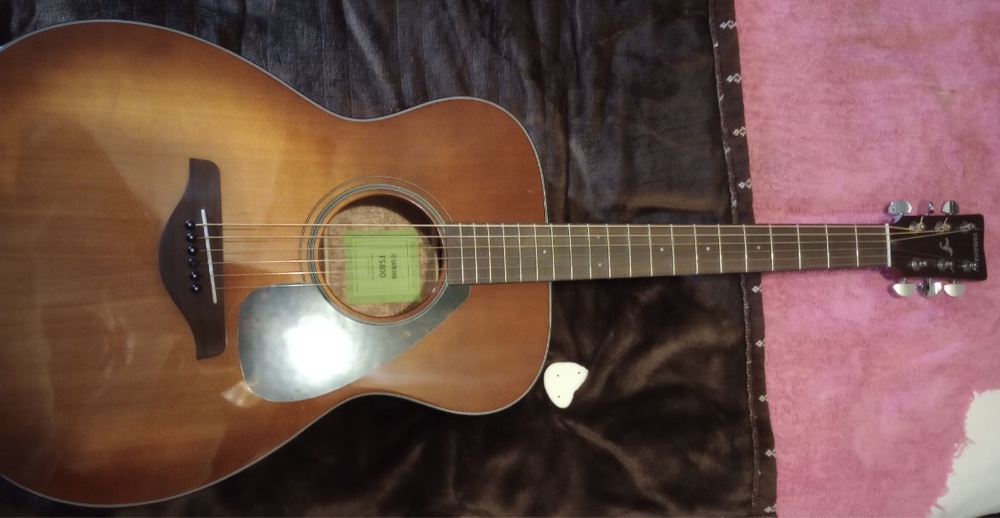
Yamaha FS800 comes with a long standing reputation as an excellent beginner and intermediate guitar. This concert size guitar has an attractive “sandburst” finish and perhaps not surprisingly, arrived in excellent condition and completely set up. Which is something about Yamaha guitars; you can generally count on them to be well built and expect for the guitar to arrive in good shape.
When picking an online store to buy a guitar, how they store the guitar and ship it can make a big difference in the condition that arrives in. That may seem like an obvious statement, but one time I received a guitar that was just shipped in a gig bag covered with thick paper with no extra padding. I’m surprised the guitar survived.
I’ve noted in another blog entry that I once traded a Gibson Country And Western for a Yamaha plus cash, which if you knew how Yamahas sounded back then, it wasn't perceived as much of a comedown in terms of having a nice sounding guitar.
There were some obvious differences in sound quality but in the 70s; Yamaha, Takamine and Washburn were considered excellent entry-level to intermediate guitars during a time when such guitars had previously been hard to come by. Back then, one often had to make do with an old Harmony or Silvertone, etc. so these companies brought to the market the then novel idea that there were inexpensive high quality guitars that could be bought new.
Sure, There were good Harmonies and Silvertones, but the Japanese companies like Yamaha and Takamine contradicted the old idea that Japanese products were junk and instead produced guitars that people began to compare with Martins, or more specifically, good enough to have a lot of what premium guitars offered but at a fraction of the cost. People are used to that now with a multitude of companies, but back in the early and mid 70s, you sort of had to be there to see what a change in the guitar landscape the Japanese guitar companies brought.
For example, this FS 800 would be the kind of guitar that older players would wish were around back when they were first learning guitar. The idea that there were acoustic guitars with low action, nice construction like scalloped bracing with decent looks (ie. Looked like a Martin) would have made the old advice to buy a nylon string guitar first a thing of the past, since that advice was really about toughening the fingers up for playing acoustic guitars with high action.
This Yamaha model has been around long enough that you can check out YouTube videos to hear it played at all levels of skill, which is something I’ve always advocated. Seeing a beginner play the guitar on YouTube will often give you a clue as to how you might sound when you first start playing (and reduce any embarrassment over early mistakes, etc).
In terms of this review, I would say that the FS800 when finger picked has a smooth, mellow sound, though because of the compromise necessary to make it also a good guitar for strumming (the more common usage), the bass can overpower the mids and treble. You'll have to make some allowance for that when finger picking but by the same token, it makes for a really nice rhythm guitar for accompaniment. Also, certain types of flat picking sound better when you have strong bass and mids.
The level of balance between the strings is good enough that you can make adjustments to have an equal amount of volume, something you can’t always do with a cheapo guitar. Another way to put it, it could be that the strong bass (lows) and mids can help a beginner when first learning chords, then as they get better, they can make minor adjustments in their technique to have a nice balanced sound.
My main acoustic is a Gibson and an old Regal parlor but the Yamaha is an excellent third guitar to keep in a different tuning. The FS800 is highly recommended for a beginner because this is the type of guitar that can make him or her sound good all the way up to the intermediate levels and to enjoy the process.
Believe me, back in the 70s it wasn’t a given that you could have both good sound and a pleasurable playing experience. So, to use an old phrase, yes, I do wish there were more guitars like this when I was first starting.
Al Handa
July 23, 2026
Specs:
Top Material Spruce Wood
Body Material Mahogany
Back Material Rosewood
Neck Material Nato Wood
Fretboard Material Rosewood
Body type: Concert/O
Cutaway: Non-cutaway
Top wood: Solid Spruce
Back & sides: Nato/okume
Bracing pattern: Scalloped
Body finish: Gloss
Orientation: Right handed
Nut width: 1.69" (43 mm)
Fingerboard: Rosewood
Neck wood: Nato
Scale length: 25"
Number of frets: 20
Neck finish: Matte
Pickup/preamp: No
Headstock overlay: Rosewood
Tuning machines: Die-cast chrome
Bridge: Rosewood
Saddle & nut: Urea
Number of strings: 6-string
 |
 |
 |
 |
 |
 |
 |
 |
 |
 |

