

 |
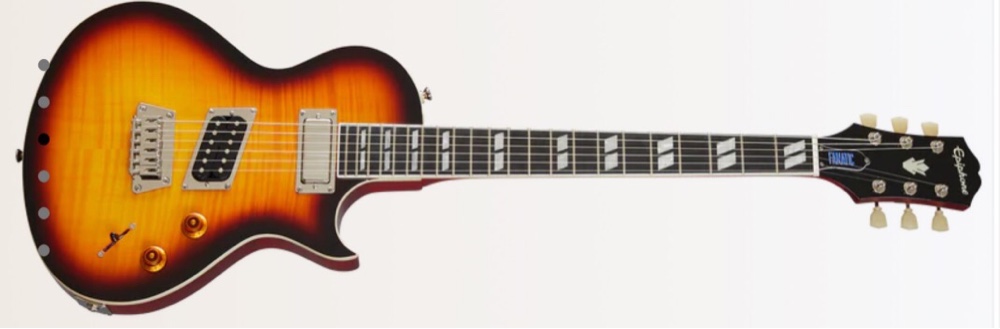
Review: 2010 Epiphone Nancy Wilson Fanatic Nighthawk
My experience with the 2010 Nancy Wilson Fanatic was with a used one in 2014. I got one after experimenting with the Bill Lawrence and Epiphone Custom versions. I’ll review the latter separately because its complex switching system should be discussed in detail and keep this review mainly about the Nancy Wilson version. I’ll occasionally reference the Bill Lawrence review that you can find on the site here.
I didn’t get it because it was named after Nancy Wilson, though there’s nothing wrong with her guitar playing, it’s just that when I read an article about her version, I was willing to give it a try because it was a Nighthawk (I’ll go into why shortly).
The difference between the original Nighthawk (the two pickup model) with the Nancy Wilson version is that it was customized to her preferences and that apparently meant Gibson type Burstbucker Pros. The article didn’t say why she had decided to have those humbuckers instead of keeping the original Bill Lawrence pick ups.
With the Bill Lawrence version, which was designed more or less to be a Strat type guitar, the Nancy Wilson was a pure Gibson in terms of its body, design and some of the hardware. Also, it had an attractive “fire burst” finish, which I thought was an improvement over the original Nighthawk.
When referring to the original Nighthawk, I mean the one reviewed elsewhere on this site. That’s the one I owned and it was part of a larger product line, so I can’t really speak for the others (like the three pickup version).
I’ll explain why I moved on from the Nighthawks so as to not appear utterly feckless in my GAS. Why I never kept one goes back to why I bought them in the first place.
My main problem with Strats, for example, was that I could never get it to sound like early electric Hot Tuna, which is the reason I got one (of many). I was aware of SGs because of The Who and other English groups but none of them made me want to get one until I heard that one of the guitar players in Quicksilver was John Coppolina, who played an SG with finger picks. So, you can see that was the association; my heroes were finger pickers who happened to play electrics.
So that was the same situation with the Bill Lawrence version of the Nighthawk. I got it because Jorma Kaukonen of Hot Tuna had begun playing one. That brought it to my attention but like the Strat, it didn’t give me the Hot Tuna sound, and it goes without saying that I had to eventually come around to the realization that I was always going to sound like myself.
So, anyway, there was a used Nancy Wilson at one of my favorite guitar stores where I was trading in a couple of guitars. I had evaluated them, etc. and those were found wanting, so to speak, after a couple of months. I saw the used Nancy Wilson and that was how it came into my possession. I was still at the stage where I was willing to give a Nighthawk yet another try.
I took it to a couple rehearsals, etc. played it and developed the same impression I got from the Bill Lawrence version; that it was a very fine guitar with excellent ergonomics. The Wilson Fanatic didn’t have the original “Nighthawk sound”, even with that five way switch, because we’re talking about different pickups, the burstbucker and mini humbucker. Which I should add is a pretty good combination, I’ve always personally liked the Gibson mini humbuckers.
The vintage voiced Burstbucker 3 and the 1960 Firebird style ProBucker FB720 (mini HB) will give you a vintage sound that's like an SG, Les Paul or Firebird; how it sounds in your hands will come down to technique, the amp you’re using, all the usual elements. I’ll add, abd this is my opinion, that if you think it’s a Les Paul type guitar, that’s what you’re gonna hear and if you think it’s an SG, it will have a bit of an SG flavor and so on. If you prefer the Nighthawk, it probably means that if you’re looking for something that is similar but not one of the usual Gibson archetypes, this guitar can give you something a little different.
Also given the profile, a buyer might be someone who's interested in a lighter guitar than a Les Paul, etc. One should never underestimate ergonomics in the decision making process; quite a few players do that even if they don't rest necessarily rank it as high as the sound, it does come into play. With this guitar, I think you’re dealing with a classic Gibson mahogany guitar with Les Paul derived body but with a slightly longer scale. One could say like Fender scale but I would put it as feeling a bit more like an SG.
If the sound is somewhere in between those classic guitars, that means you can take it further towards where you want to go, with the five PU settings. The different sounds you get with the five positions are certainly something to consider when evaluating one. Here’s the five positions:
Position 1 (all the way back towards the bridge): Activates only the bottom/rear coil of the slanted bridge humbucker (single-coil tone).
Position 2: Engages the full bridge humbucker.
Position 3: Selects the inside coils of both the bridge and neck pickups together for a combined split-coil sound.
Position 4: Utilizes only the inside coil of the neck pickup.
Position 5 (all the way forward): Activates the full neck mini-humbucker.
It’s a combo of humbucker and single coil splits with a Gibson flavor. The sounds reminded me of a guitar that was kind of in between a Les Paul (the Epi was described as having a LP style body) and an SG, if that makes sense.
How well the various pick up combinations work, particularly in terms of the single coil settings, will come down to how you feel about that type of pick up. There are some that don’t like a humbucker split to a single coil, and personally, I haven’t heard a lot of good ones. The one on the Wilson wasn’t bad but it’s not quite the same as a dedicated single coil. Again, that’s my opinion, but I’m not the only one that thinks that. However, the middle position that combines the two single coils has a clear and full bite and was my next favorite setting after the full mini.
Used copies are still reasonably priced, around a few hundred dollars and in terms of what you’re getting, it’s probably at least as good as a Mexican Strat or telecaster or an older Les Paul special before they reached 2026 level prices. In terms of approximate numbers, what I’m saying is a Nancy Wilson at around five to $600 is as good as a new Mexican strat and due to its lower price, a possible bargain for what you’re getting. A lot of relative values are psychological, In the right hand and Nancy Wilson Fanatic will probably take you further than a Strat would if you’re looking for something different.
Al Handa
2014 notes, not finished for Epinions.com, revised 2026.
Specifications:
Body Specs
Binding
Single-ply White
Body Finish
Gloss
Body Material
Mahogany
Body Shape
Nighthawk
Body Styles
Les Paul
Top
Figured Maple Veneer
Neck Specs
Fingerboard Material
Ebony
Fingerboard Radius
305.0mm / 12.01in
Fret Count
22
Frets
Medium Jumbo
Inlays
Twin Parallelogram in Pearloid
Joint
Glued in at 16th fret
Neck Material
Mahogany
Nut Material
Graph Tech® NuBone®
Nut Width
43.0mm / 1.69in
Profile
Rounded C
Scale Length
648.0mm / 25.51in
Electronics Specs
Bridge Pickup
ProBucker 3
Controls
Master Volume, Master Tone
Neck Pickup
ProBucker FB720
Output Jack
1/4"
Pickup Selector
5-way switch
Hardware Specs
Bridge
Nighthawk Hardtail
Control Covers
Black
Control Knobs
Amber Top Hats
Finish
Nickel
Pickup Covers
Nickel
Strap Buttons
2 - bottom and shoulder
Switch Tip
Black
Tailpiece
Through body
Truss Rod
Dual Action
Truss Rod Cover
2--ply bell - black/white
Tuner Plating
Nickel
Tuning Machines
Epiphone Deluxe
Misc Specs
Case
Hardshell Case
Model:
ENNWFBNH3
Headstock
60s Kalamazoo, Nancy Wilson signature on back
Headstock Inlay
Epiphone logo in Mother of Pearl, Gibson Crown in Mother of Pearl
 |
 |
 |
 |
 |
 |
 |
 |
 |
 |

