

 |
Vintage Review And Essay: 1999 Rogue STR-1 Pro Electric Sitar Guitar vs. Traditional Sitar
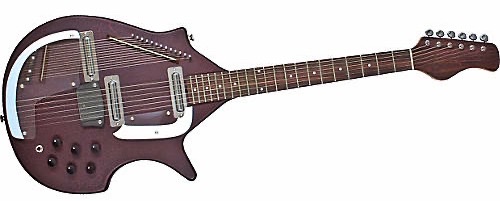
Rogue, a company that was well known in the 90s as a maker of economy instruments (and still around) released a close copy of the now legendary Corel electric sitar-guitar. It’s a well documented instrument and if you’re interested, well worth a deeper dive into the various resources available on the Internet.
I bought a used copy in the early 2000s and to be clear, only owned it for a few days because it was more a part of my own exploration of world music, of which a lot of the early music of the group I'm in Hannah McGraw International specialized in. The thing about the Rogue Coral copy was that it was a fun instrument in rehearsal but as it cost almost $350, I felt that was a fairly high amount (for the late 90s) for a single voice instrument.
The main reason I bought it was because it seemed like it might be easier to maintain than the real sitar I owned at the time; which in retrospect wasn’t that hard to tune up and maintain, the only difference being friction tuners compared to geared. As my early years as a musician was spent playing the violin, tuning was hardly a problem.
I could see why the Beatles and the Stones used a real sitar instead of trying to use some sort of an electric version (or like the Kinks, play a modal scale on guitar); regular sitars are almost as easy to play as guitars. All you have to do is figure out how it’ll sit it in your lap and the sitar metal rings, or frets as you will, are somewhat easier to produce notes on because it's a linear neck as opposed to six strings tuned to fourths or whatever.
Also, all those extra strings on the side on a real sitar or on the Rogue only make the instrument look harder to play; those are basically sympathetic strings, designed to vibrate as the instrument is being played. The sound is basically like added overtones. So on the Rogue it was the six plus a lot of other strings that you could say were tuned like an autoharp (and can be played like one, which I've seen Steve Miller do in concert on his vintage Corel).
If you're a music historian or someone who enjoys reading a lot about the history of rock and roll, the Corel was featured in a couple of pop hits by the Box Tops, B.J. Thomas, and others but never gained a lot of traction here or in Asian markets; that is to say, it didn't become a major instrument like the guitar is in western culture but it’s always stayed a well liked niche music voice.
One reason the electric sitar didn’t take Asia by storm was simply because a real sitar only seems more difficult to maintain; it's not that hard if you are used to taking care of a violin, for example, or an expensive (and delicate) acoustic guitar. The sympathetic strings just need to be tuned every so often like a harp and since they're not played, don’t constantly go out of tune.
The bottom line is that the tone wasn't superior to a real sitar and in India, it's not that hard to get a sitar. There are many levels of quality just like Americans have with guitars. As far as replacing real sitar, A Rogue (or Corel) would be considered a similar replacement as an electric guitar for an acoustic in Western music; in other words, it’s really a case of apples and oranges.
One of the main reasons I returned my Rogue was because it became obvious that the mechanism to create the sitar sound was actually quite simple and if you really wanted to, could duplicate the effect on a regular guitar or a cheapy that you're willing to modify.
In short, the electric sitar effect was created by a lever that raised a plastic rectangle up until it barely made contact with the vibrating strings and started to buzz and then amplified the sound. If you’ve ever seen a guitar where the strings are buzzing against the frets, that's the exact same mechanism. Except the Rogue can do that deliberately and the effect can be adjusted.
So, that was my adventure with the electric sitar, which I will add, if you want that sound, then the Rogue is as good as any. A fan of the vintage Coral or the issues might differ but basically considering that it's a mechanical sound that is processed electronically, it's as good a way to get that sound as any. Also, these days, you can get that effect with a pedal.
That’s my impression, or recollection of the Rogue electric sitar, which I liked but again, for one sound, I think it would be better to get a pedal which can do the same thing or to get a Variax guitar or amp that has a sitar effect. The advantage to the latter would be being able to get a dozen other simulations of other instruments too.
Now, if you're playing in an Asian band, you could probably find more utility in a Rogue or Corel, particularly in the world beat and electronic genres. Otherwise, it’s difficult to recommend this instrument unless you really want one; this particular type of, I guess we can call it a guitar, is a fairly fairly expensive way to get one effect.
However, like any other instrument these days, it can be researched on YouTube and afterwards, if you think it fits your sound, I certainly wouldn't say don't buy one. After all, whatever my reasons for returning it, I did note that it was a lot of fun to play and ultimately, that’s what counts.
Al Handa
July 28, 2026
I'm listing the tuning for the sympathetic strings here in this review, not that it necessarily adds that much information, but it does give you a feel as to what it took to maintain and tune the thing.
Specs:
6 guitar strings
13 sympathetic drone strings
Buzzing Gotoh bridge
3 pickups (including the sympathetic-string pickup)
Independent tone and volume controls.
Sympathetic Strings Tuning:
The Top and lowest string is tuned an octave above the high E of a standard tuned guitar. From there the strings are tuned in half steps. This is just a starting point and experimentation can yield some beautiful sounds.
D - same note as 1st string of the guitar neck fretted at the 10th fret (the 1st string is tuned to standard E)
F# - ascending
G - ascending
A - ascending
C - ascending
A - ascending
G - ascending
F# - ascending
G - ascending
A - ascending
C - ascending
D - ascending
D - same as previous note
 |
 |
 |
 |
 |
 |
 |
 |
 |
 |

