

 |
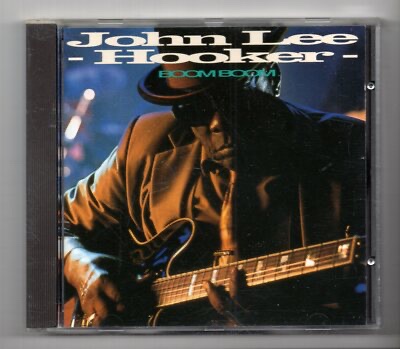
Classic Album Review: Boom Boom by John Lee Hooker (Point Blank Records 1992)
John Lee Hooker is one of the most famous "stylists" in the blues. I'd be hard pressed to find anyone exactly like him. His large body of work hasn't produced as many classic songs as, say, Muddy, but the Hooker style has been one of the most imitated.
The Hooker trademark is his famous "boogie," which is more of an approach than anything else. Basically, it's a medium to fast repetitive pattern that, done right, can be almost hypnotic. In many of Hooker's early boogies, the beat was based on a four to the bar stomp on a wood floor, and was the foundation on which he would improvise lyrics and music.
The archetype Hooker slow song is that same beat slowed to a crawl, with guitar work that was so abstract at times that it became atmospheric and at times, surreal. The most famous example might be his "Crawling King Snake."
Many of the song titles are interchangable, generally being the version of a boogie captured in that particular recording session. This made economic sense in the early days, when blues artists were often paid a flat (and generally pretty low) fee for a recording session (that then became singles and albums).
That old recording philosophy can make buying large numbers of his solo recordings redundant, since most can be pretty samey. In fact, one could get by with the King reissue of his late 40's and early 50's recordings which
has his earliest hit, "Boogie Chillun," and still stand as his best solo recordings.
Hooker did do group sessions, of course. One of the most extensive early efforts were on the Vee-Jay label, backed by the same band (with Eddie Taylor on second guitar) who played the Elmore James sessions. I've seen mixed reviews on those sessions, some writers feeling that the music didn't capture the spirit very well.
However, many of the songs done on Vee-Jay are the ones that to this day are identified with him. A brief list would include: "Boom, Boom," "Maudie," and "Want Ad Blues." There is a Chess set, the name of which escapes me at the moment, and a very loose live set about that same era, which produced "One Whiskey, One Bourbon, One Beer" (later combined with "House Rent Blues" by George
Thorogood).
Later, in the 60's and 70's, there were ABC Records releases which created renewed interest in Hooker's music, but tended to try and fit his often undisciplined style into more straight-ahead tempos. The records were well produced, but often reduced his genius into rather average rock boogie.
The Vee-Jay recordings did point to the most successful way to present Hooker in a group setting. The producer focused on his voice, which really is the basis of his talent, and let Hooker play the most guitar on his solo cuts. In fact, very few of the slow blues on any Vee-Jay record were done with a group, a clear recognition of the instinctive approach Hooker used.
The Chess and later attempts did the opposite, which was to let him play and have the group follow it the best they could, with often clunky and off-kilter results. In the "Live At The Cafe-Au Go Go" record, it almost sounds at times like someone was playing two separate records at once, Hooker on one, and a pretty good (but probably bewildered) Chicago Band on the other.
It's the age old mistake of thinking a blues artist is a guitarist or pianist, and not a singer who plays an instrument. If a group supports Hooker the great singer, and leaves a little room for some guitar, you get a "Boom, Boom." Try to back Hooker the guitarist, and you get a record only a fanatic blues fan would buy and treat as genius.
In the late 80's and 90's, it seems that the best Hooker has been when the various producers do what the Vee-Jay people did, and focus on Hooker's true genius, which is his singing. One example is this 1992 Pointblank/Charisma recording. Producer Roy Rogers assembled an all-star cast of supporting musicians and made Hooker a classic style front man, who plays some guitar. The result is a very coherent set, with structured room for the idiosyncratic playing. Also, Rogers appears to have understood the basic approach of any Hooker slow blues, and used the music to enhance the atmospheric feel, as opposed to simply having the guys play a slow 12 bar and expecting Hooker to follow the chord changes (fat chance of that).
The set opens with the old chestnut, "Boom, Boom." It's basically identical in arrangement to the old Vee-Jay version, but is played more aggressively and features some great guitar by Jimmie Vaughn. Also, the arrangement lets Hooker and the band stretch out, and it's hard to dislike any loose, improvised Hook. Redundant perhaps to some old fans, but it could be a revelation to the newer ones.
Next is one of his better modern songs, "I'm Bad Like Jesse James." It's done solo, and in his "Crawling King Snake" style. I'd prefer the King solo stuff, since it's old hat to me, but it's beautifully recorded, and the vocal improvisations inspired.
"Same Old Blues Again," comes next, and is another slow one in the Chicago mold. Producer Rogers placed Hooker in here as the vocalist behind a crack band featuring Robert Cray and Tim Kaihatsu. The keyboardist Jimmy Pugh adds some good atmospherics, and the result is a great Hooker performance, with as said earlier, some guitar thrown in. "Sugar Mama" follows, and is a slow one, done solo. It slows the pace even more (with Hooker, slow blues has many tempos), and his guitar work is outstanding. Some of the best Delta-drenched stuff I've heard for some years.
"Trick Bag (Shoppin' For My Tombstone)" picks the tempo back up (slow as opposed to crawling) and has a tough feel to it. The piano work by Mitch Woods interacts with Hooker's leads perfectly. This leads to "Boogie At
Russian Hill," a "Green Onions" style boogie with good organ work by Deacon Jones, and great ripping guitar by the immortal Albert Collins. The lyrics are nothing special, being your standard honor to the geographic location of the session or whatever, but then, the actual lyrics aren't the point of a good Hooker song anyway. It's always the voice, and like James Brown, he can sing great even in his sleep.
A sort of calypso-country song done on a national steel guitar comes next called "Hittin' The Bottle Again." Hearing Hooker sing this world-weary lyric can remind even the oldest fan that when he feels like it, his voice can sing anything.
"Bottle Up And Go" has the feel of a John Hammond cut, which isn't surprising as Hammond is playing guitar and harp with him. It has a good laid back rhythm (provided by Steve Ehrmann and Scott Mathews), and the usual great bottle neck and harp work. It's a Hookerized version of the old "Step It Up And Go," but in many ways, a very different song.
"Thought I Heard" is a duet, with Charlie Musselwhite on harp. It's a slow, very moody piece, and Musselwhite's harp work shows once again why he's one of THE best. You can't beat Charlie's tone on a Delta-style arrangement, and I found the music here very compelling.
The set closes with "I Ain't Gonna Suffer No More." It's a medium tempo slow blues, with a Chicago feel. The arrangement has been changed to fit Hooker's feel for slow ones, and it sends the listener off with some fine vocals, and given a steady bottom, some aggressive and listenable guitar.
All in all, I would imagine even the old timers would enjoy this one. If you have a lot of Hooker already, you might still enjoy the good sound and arrangements. It is a well-produced set. For a new listener, this could be an ideal introduction to the Hook, with sound quality fit for the modern CD player, yet sung with real emotion and feel.
Most importantly, for the newer listener still discovering the Blues, it's important to realize that there aren't very many true legends still alive and recording. Hooker is one of those, one of the originals, whose "style" influenced a great many modern rockers and produced some big hits. A good record by someone like Hooker recorded in the 90's is much more than some well annotated reissue of Chess classics or something. It's in a sense, history still being made and a chance to connect with newly created music by a legend from an era we can now only read about.
Al Handa
Dec. 1995
 |
 |
 |
 |
 |
 |
 |
 |
 |

