

 |
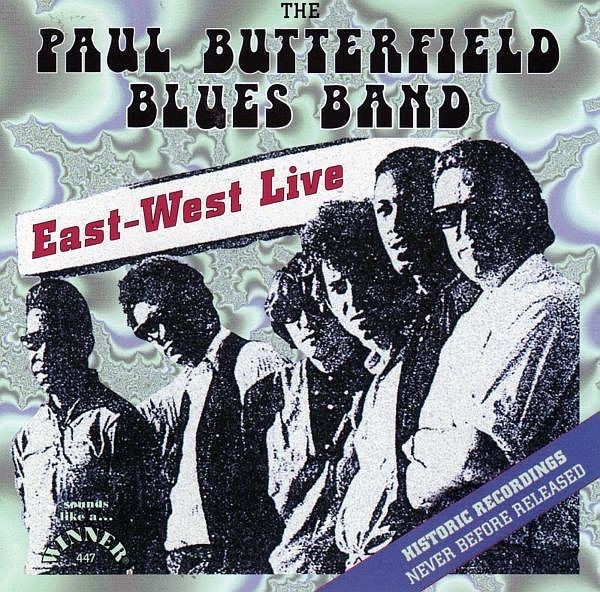
ClassicAlbum Review: East-West Live - Paul Butterfield Blues Band (Winner Records)
Note: This review originally appeared in the Delta August 1997 Snake E-zine.
One of the nicer things about the latest surge in interest about the blues has been the increased attention to the contributions of the Butterfield Blues Band. A great deal has been written about that
legendary band, including in the Snake (see my review of "Strawberry Jam") so I'll focus on a narrower aspect of that great band's talent highlighted here in this CD from Mark Naftalin’s Winner Records label. I should note that the Strawberry Jam CD is also from Winner Records.
In rock, and even blues to a large extent, musicians and bands tend to be remembered by their songs. This can overlook a key aspect of the blues, which is that it is in the main an improvisational art form not unlike jazz. The tendency to focus on studio performances can accidentally make a blues classic a sacred text, to be performed note for note, or with close adherence to the style.
In baroque music, for example, Bach compositions are often played to a known arrangement, when in reality, the composer often improvised new variations when playing live, and on the score, would write in alternate routes the musician could take. Over time, classical lost that improvisational spirit, and presuming to change a Mozart piece could get a player in trouble with the critics and fans.
Thus, to some, the idea of a CD with three versions of the same song could seem redundant. To some, it could seem like a Beatle release with several versions of "Hey Jude (which I must admit, would seem redundant to me ;-)). However, "East-West" wasn't just a rock or pop song. It was also a vehicle for improvisation that had a far reaching effect on the rock scene of the 60's beyond even the psychedelic bands. John Fogerty, a master of the rock single, even mentioned in an interview that seeing the Butterfield Blues Band play "East-West" was what gave him the idea for the extended version of "Suzy-Q" that was his band's
first hit.
Even a cursory listen to the three versions here will make it obvious that the music here had a freedom one associates with jazz (but is indeed always present in great blues). The early versions are closer to the studio version and the last is a nearly half-hour exploration that moves into a realm one couldn't really pin down as pure rock or blues.
It's more of an evolution and exploration, in which the last becomes the most free in a sonic sense. By 1967, the band had played it for over a year, and some of the sections show them collectively exploring and producing sounds where individual intention and sound merged into a single sonic idea as opposed to people taking turns soloing. By the same token, the same cuts have moments of total individuality, which move the others to literally live in that moment and move with it...Or not, for that matter, which created some interesting textures and rhythmic tension.
That being said, the earlier versions do have their attractions. Although more restrained, the performances have the beauty of the original studio themes and ideas being put into a fuller and freer context. There is much melodic intensity in the early cuts, so in the end, each of the performances have to be taken as much as unique moments in time as progressions towards some perfection. After all, in the case of "East-West," what would constitute a "perfect" version?
One thing is also obvious; one of the true stars of this CD is the rhythm section. Although there has always been a great deal of focus on Butterfield and Bloomfield, none of these cuts would have worked without a great band, anchored by a great rhythm section. This isn't unusual. The great STAX recordings were due in no small part to the great studio band of Booker T and the MG's. Atlantic's classic soul sound was more than partly defined by the great Muscle Shoals band, and the same for Motown and Hi-Rhythm for that matter.
Given the freedom that Bloomfield, Butterfield, Naftalin, and Bishop enjoyed in these performances, one can see that an unsympathetic rhythm section could have pulled these jams down to the level of an atonal boogie or bad psychedelic noodling. If these versions have such life, it was also due to a bassist and drummer who could provide a pulse and continuity that was both an anchor, and a free path where new textures could be explored.
Obviously, those textures and ideas could stand alone, but we're also talking about what the average listener will enjoy also, so talking about pulse is also about what sounds good. A great rhythm section can do that, provide a vehicle for musicians to improvise and explore, and be that bridge for the average listener.
So, while this CD is a both a document and celebration of a blues band that is now seen as the legendary unit that it was, it is also a tribute to the work of bassist Jerome Arnold and drummer Billy
Davenport. A rhythm section as great as any that ever played, in a band that was as great as any.
Al Handa
August 1997
 |
 |
 |
 |
 |
 |
 |
 |

