

 |
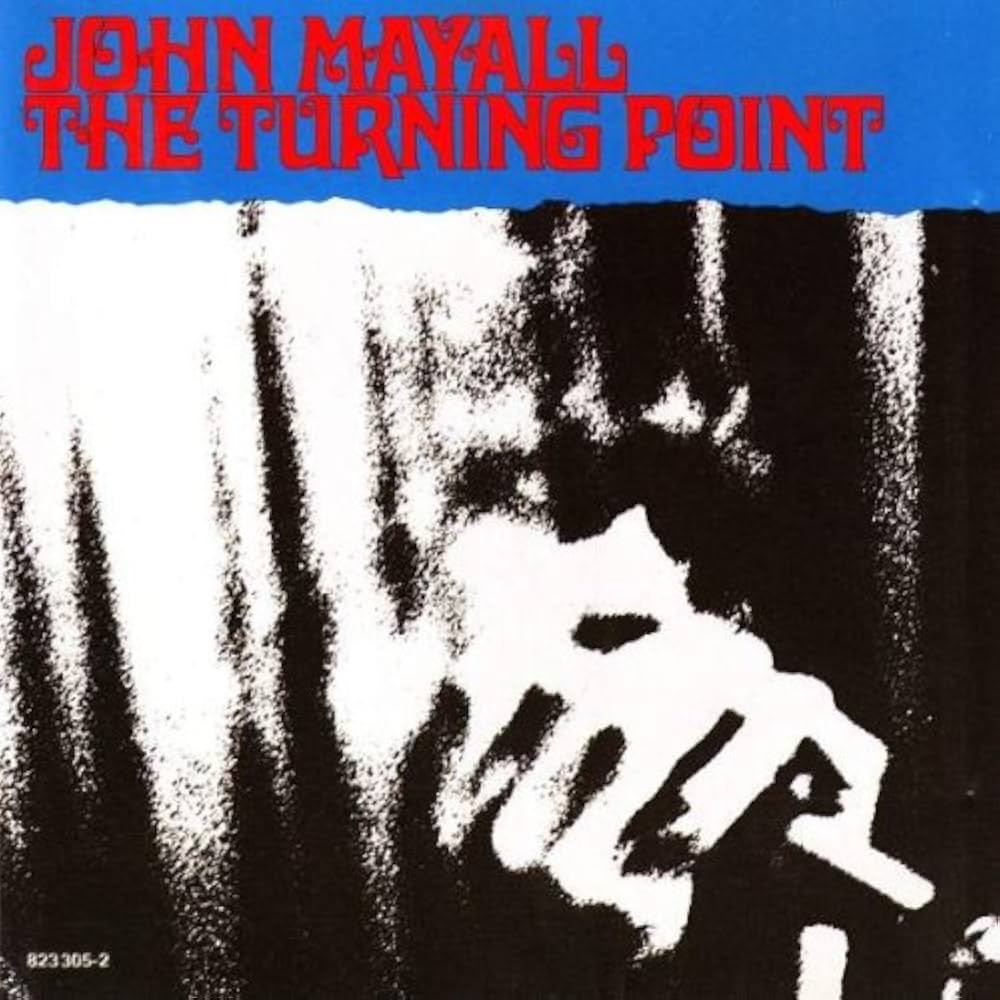
Classic Album Review: The Turning Point - John Mayall (Polydor)
Note: This review originally appeared in the May 1995 Delta Snake E-zine and is reprinted here with some minor changes.
John Mayall has always been John Mayall, but the pigeonholing he's endured must have been trying. At times, he's been described as the purist who kept the true Blues alive while other English artist turned up the amps, a great bandleader who was overshadowed by his pupils, or Blues artist whose output ranged from brilliant to mediocre, often within the confines of a
single record.
One thing that is important to note, is that he grew up on American Jazz, and that an early influence was Alexis Korner, who was a traditionalist, which is to say, understood that 20's and 30's Black music incorporated both a Blues and Jazz tradition. This, in my opinion, is the source of a lot of misunderstandings about his later music. Too many writers have used his later work with the Bluesbreakers as the main reference point, and thus have explained or misunderstood his later music in that context.
The correct way to see his music is that the Bluesbreakers period was merely one of many phases he went through, and that the music he made with Clapton, Green, and Taylor, although the most celebrated, wasn't the core of his outlook on the Blues. His later jazz-influenced work wasn't a departure, but a return to an earlier point of reference.
His recording career began with a couple of 45s, one of which was the brilliant "I'm Your Witchdoctor," which was a Bo Diddley-derived Blues rocker that staked out territory later mined by the Stones. However, he veered back towards hard Blues in a now famous partnership with Eric Clapton, who had then just left the Yardbirds (who he felt were going in a "pop" direction). The resulting album was, and still considered a classic of British Blues. Also, the series of records made with Peter Green and Mick Taylor were also great, and Mayall began to become as famous for the numerous sidemen who came through his various Bluesbreaker line-ups as for his music.
In 1969, he surprised his many fans by making what seemed to be a radical move towards jazz, and even more shocking, not using a drummer. The record was "The Turning Point," in which Mayall led a quartet consisting of himself, John Almond on flute and saxes, John Mark on guitar, and Steve Thompson on bass. At the time, it was considered a big deal to use a bassist to carry the rhythm. Also, the low key quality of the music was considered was departure from the ever increasing volume of the rock-flavored Blues of the time.
In retrospect, that was a myopic view, as drums have never been a requirement to play Blues, and jazz artists have been playing Blues for as long as the genre ever existed, so even Mayall's new jazzy sound wasn't that revolutionary. That is, in the great scheme of things. In the rock world, it did seem to be. The record consisted of eight tracks, most of which were long jazz-blues grooves anchored by a steady bass. The overall feel was that of a low-key after-hours jam. So describing the music track by
track doesn't describe what was really going on.
The first two numbers seem to blend together, consisting of grooves that Mayall and Almond improvise over. The feel is spacious, and at times sounds like an early 70's Traffic cut, but with a definite Blues underpinning. The third number, "I'm Going To Fight For You J.B." is about the great Chicago Bluesman J.B. Lenoir, and is done as a slow, rolling Blues. It opens with a Delta feel, then gradually Almond comes in over a Chicago style bottom and the mood shifts and builds.
The side ends with "So Hard To Share," which opens with a medium tempo R&B; style bass figure, and then moves subtly into a lyric Jazz-Blues when Jon Mark's rhythm guitar shifts to fast chording. "California" goes into a bass walk and the jamming becomes intense, then the pace slows with "Roxanne." The record closes with the frenetic "Room To Move," which is still an AOR staple. It's a harp boogie, in the pre-war style, in which Mayall goes on a tear and shows what a harmonica can do without distortion and other devices.
This is a record that still surprises me now and then, with some solo or texture missed in earlier listenings suddenly coming to light. It was one of his most successful outings, both artistically and commercially, and influence his direction for the next few years. When looking back at an old album, one can see that there's two reasons for a record to be esteemed at the time. One, the symbolism of the music, which in this case was the seemingly radical departure from the directions set by Cream and Fleetwood Mac. Second, how well the music stands the test of time.
"Turning Point" stands the test of time because in the end, although the symbolism of doing without a drummer was more of a stylistic change, the jazz direction worked because the quality of musicianship was very high. More importantly, Mayall in reality knew jazz very well, and knew how to create a Jazz-Blues fusion. The record was really a change in direction, and not simply an experiment. So, for that reason, the title of the record is more about a bend in the road than a departure.
The Turning Point Tracks:
1. The Laws Must Change
2. Saw Mill Gulch Road
3. I'm Gonna Fight For You J.B.
4. So Hard To Share
5. California
6. Thoughts About Roxanne
7. Room To Move
Al Handa
May 1998
 |
 |
 |
 |
 |
 |
 |
 |
 |

