
 |
Retrospective: Gibson Les Paul Specials of the 1990s to 2000s era
Note: While doing some work on an Epiphone Les Paul Special that I’m contemplating customizing into a copy of the Gibson Bob Marley Tribute LP Special, these thoughts about the Specials came to mind.
There were a couple of decades or so when it was easy to take Les Paul Specials for granted, from the extremely low cost ones to the better ones with nice finishes. I’m talking about the ones in the late 80s to around the advent of the “faded” series types of the 2000s.
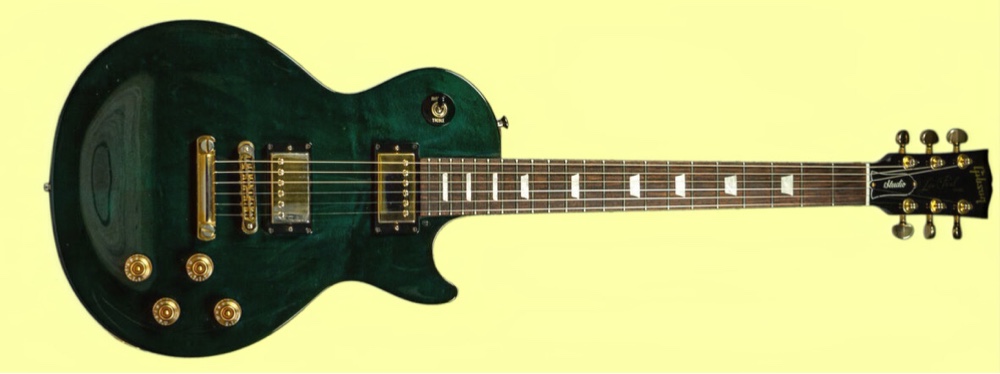
I think in retrospect that the 1990s-2000s Gibson Les Paul Specials were a fine value and often very underrated. You could get an incredibly wide range, like from inexpensive ones that didn't have mahogany bodies (and not considered Specials), mahogany body types with P90s or P100s, the faded series which were both overrated and underrated with regular or burstbucker type humbuckers, and one of my favorites, the type where the new feature was simply an unusual finish, like the very nice 2000 emerald green Special.
Many of these went through my collection and stayed for various periods of time and the turnover wasn't because I was being fickle but because the prices on these particular Gibsons, both new and used, were reasonable enough that one could experiment, trade, and explore the various types.
Since the Specials had a lot less emphasis on cosmetics, and the features were mainly different in terms of pickups and smaller hardware pieces, it makes it feel like I’d be creating filler to give each a full review, so I’m taking a few that were in my collection for various lengths of time and talk about those in the short takes format. Adding to the lore as I've said before.
Nowadays, particularly post-covid, when you buy a LP Studio it's practically an investment level purchase at the same price of a 1990s or 2000 Les Paul Custom or something. Modern studios are supposed to be the Les Paul's that anyone can afford (if you don’t need ones with binding, etc,) but the price range of these make that almost a silly assertion these days.
However, back then, Gibson pretty much succeeded in what they were trying to do with the Specials, which was to give players a lot of the features of the Les Pauls, sans cosmetics and give them what they really wanted, a Gibson with top of the line pickups and hardware.
Also, the purpose of the various Specials were to compete with the various other brands and Les Paul clones, like the Agile LP in 2000 (and others earlier). The Epiphone versions couldn't always compete with the higher rated copies like that Agile which often had people swearing to the guitar gods that the secret to the Gibsons had been unlocked. That wasn't entirely untrue; the fact was the Les Paul simply isn't that complicated the guitar to create, for all the talk about craftsmanship etc it's basically a plank with or without a carved top.
On the other hand, Gibson mojo did exist and to a large extent still does. The Les Paul legend, as you will, has survived quite a few challenges and for all the sniping and criticism, still persists and older Les Pauls definitely keep their value. In addition, the numerous lower cost LPs have all pretty much not only kept their value but in many cases are in vintage territory.
In retrospect, much of the criticism of themvarious Specials were simply that the regular Les Pauls had an aura and it didn't matter how good or much of a bargain the Special was, it was considered a compromise and even today, I imagine a lot of Gibson owners don't look back at those Specials with any fondness.
However that period with all those Specials was probably one of the last times where your average guitar buyer could get a hold of a Gibson and actually make a rational decision whether to keep it or not, whether it really was for them and if not, they had the same flexibility that a Fender owner, for example, had in terms of exploring what they really wanted.
The new Specials are “inspired by Gibson Epiphones,” that have already climbed in price to the level of 1990 to 2000 era Les Paul's and I'm not sure they have anywhere near the aura. The Epiphone, which is a brand I like, doesn't quite have the cache that the Squier has for Fender owners. I would hesitate to treat Specials as generic like, for example, the slab double cut Les Paul, which was actually a respectable model with good sound.
The main reason I didn't like the double cut was because the slab type body looks better, in my opinion, with a single cut but not a double, which without any kind of extra carving looks primitive and feels a little cheap.
On the other hand, Les Paul double cuts have a nice history; there were a lot of famous rockers from the '60s and 70s playing them, and it's not simply because they were cheaper. Double cuts had a good sound though one rarely hears much about those in memoirs. It was a very workman-like guitar that saw a lot of action but never quite had the mojo of, say, other less expensive Les Paul Special types like the Melody Makers, etc.
I would have to say the nicest one was the emerald finish model, which looking back and reading about it, now realize it has become a pretty rare guitar. The only one I ever saw was in a used guitar store, and I did buy it. It was pretty well relic’d, to put it mildly. The strong point was that it had a nicer sound that made it stand out amongst the somewhat anonymous stream of Les Paul Specials that went through my collection and judging from other remarks by past owners, I don't think I was the only one who noticed that this one had some special qualities in terms of its sound.
In my case, Gibson Les Paul's were kind of like strats; I admired the sound a great but I wasn't wild about the style or ergonomics. In the case of the emerald, it was heavier than most Les Pauls. So I traded it back in and moved on but in the back of my mind, almost a couple of decades down the line, I find that I still remember it as a good guitar.
I remember the faded single cut, unusually so even for that type. I remember when I bought it, a friend of mine who worked at Guitar Center gave me a discount because it was a cut out or becoming a cutout and he said “it's a guitar that players dream about.”
Now I know what he was talking about; I didn't exactly feel that at the time about this particular special, it was just such a good price that I was willing to take a chance on it and see if it was worth keeping. But the faded finish, which was unfinished almost to the point where I thought it was going to start absorbing moisture from the air or something, was too much of a deal breaker (at the time).
I have to say that the Specials were one of many types one could explore and in retrospect, kind of easy to take for granted. Nowadays I probably would have kept one or two, maybe even three of those types of faded or wine red finish Les Paul Specials. They were in a price range that made them, I think, pretty competitive with Fenders and when you hear accounts like this particular special was 380.00 on the used market, that would seem unreal in 2026 but that's how those Specials were at the time.
I think the Specials of the 90s and 2000s were good enough that they probably cannibalized the regular Les Paul line a little and that might be one reason why they've come up in price. When you look back and think that there was a time when you could spend $400 bucks on a special and truly get 80% or even 90% of a top of the line Les Paul, well, that's definitely an era that has passed and now truly missed.
Al Handa
Aug 5, 2026
General Specs:
2005 Gibson Les Paul Faded Double Cut
(with P-90 pickups). Introduced around 2003–2005, wereUSA-made models retailing for roughly $700 to $800.
Finish: Thin, porous satin/faded nitrocellulose finish (commonly in Worn Cherry, Worn Yellow, or Worn Brown) that reduced production costs.
Hardware & Electronics: Dual humbuckers (or P-90s on the Special variant) with a simplified control layout, and no body or neck binding.
2012 Faded Les Paul Special
Body: Chambered mahogany with a carved top
Neck Material: Mahogany
Fingerboard: Rosewood or baked maple (depending on exact 2012 production batch)
Pickups: Gibson BurstBucker Pro (Alnico V)
Finish: Satin/worn nitro (common colors include Worn Brown, Worn Cherry, and Blue
The 2000 Gibson Les Paul Studio in Translucent Emerald solid mahogany body, a carved plain maple top, and a set mahogany neck. It typically includes
With rosewood fingerboard, trapezoid inlays, dual humbucking pickups (490R and 498T), and gold or chrome hardware.
Body Material: Solid non-chambered mahogany back
Top Material: Carved plain maple top with visible wood grain under the transparent green finish
Finish: Translucent Emerald Green (nitrocellulose lacquer)
Binding: None (standard stripped-down Studio aesthetic with no body or neck binding)
Neck Material: Mahogany
Neck Profile: SlimTaper ('60s style) or rounded '50s profile, depending on the specific early-2000s batch
Fingerboard: Rosewood with 22 frets and a 12-inch radius
Inlays: Acrylic trapezoids (notable for featuring smaller trapezoid variants around the year 2000)
Nut Width: Approximately 1.66 inches (42 mm)
Neck Pickup: Gibson 490R Alnico humbucker
Bridge Pickup: Gibson 498T Alnico humbucker
Controls: 2 Volume, 2 Tone, 3-way toggle switch
Hardware: Gold-plated or chrome hardware options
Bridge/Tailpiece: Tune-o-matic bridge with stopbar tailpiece
Tuners: Grover tuning machines
 |
 |
 |
 |
 |
 |
 |
 |
 |
 |

